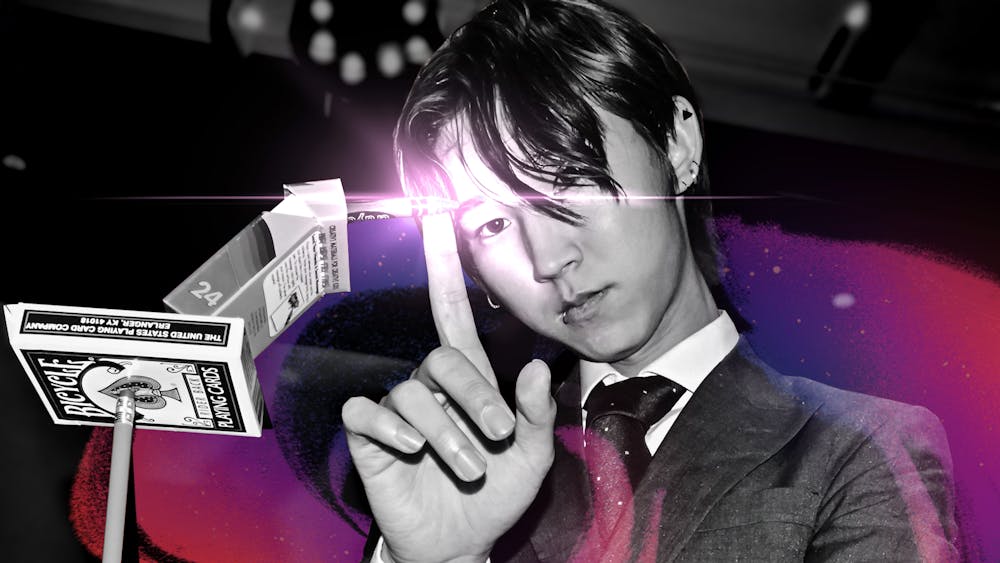
From his pocket, One An (C ’27) takes out a deck of cards, each one bearing either a black–and–white or colored image. He asks me to shuffle the deck, pick a card, then spread the rest face up in front of him. He looks at the cards for just three seconds before I gather the deck, turn it over, face down, and hand it back to him. He splits the deck into four groups. I don’t realize what he is doing until he turns each section of cards over—he’s sorting the cards by color and the object they depict. After a quick perusal, One proceeds to name which card I took out of the deck, explaining that it is just a trick of practiced memorization. Though he makes the trick seem simple in its execution, it’s hard not to be impressed.
One is majoring in logic, information and computation, submatriculating in computer science, and minoring in digital media design. He is a certified numbers obsessive. At the present, he is working on what he describes as “step index logical relations for big step semantics.” In other words, he is asking if he can understand a computer program’s behavior by how many steps it takes to evaluate something. “That would be the really annoying nerd answer,” he laughs.
But not all numbers are as rational and objective as one might think. One treats math as a slightly rigid form of storytelling. “I have this philosophical position that mathematics is just a formal version of creative writing,” he explains. It’s this interpretive framework that seems to unify One’s love of magic and his passion for mathematics. For him, the irrational and the rational go hand in hand. For the things that we cannot seem to explain—the magic of the world—there is always an answer.
Take mentalists and mind readers—the likes of which were once an inspiration for One. He explains that many are “only applied psychologists.” Or think of superstitions. “First of all, I love superstitions. I think they’re so fun,” he says. While he may not believe in them himself, he sometimes questions what it means to believe in anything at all. “I do think it’s [about] the practice of it, so I think in that way, superstitions are very real,” he says. “But is the act itself somehow causing it? No.”
It should be no surprise that card tricks are One’s bread and butter. According to him, they’re simply the mathematics of magic. One picked up trickery relatively early in life, first learning the basics of the art during his youth in Korea. “I would say Korea has a good magic culture,” he sayss and mentions the elementary school magic club where he first cut his teeth.
His dive into the deep end of sorcery truly began the moment he stepped into a Korean magic store. “The first time I was there, I was in a trance. There are people shuffling cards crazy, and people who knew how to cheat in cards. Then the dealer showed me a trick,” he says enthusiastically, “and I was like, ‘well, that’s fucking crazy.’” Since then, there’s hardly been a day when he hasn’t gone without touching a deck of cards. “I think the maximum I found was two days,” he says with a grin.
Beyond simple sleight of hand, One also finds himself immersed in the world of card matching and gamblers’ techniques. “I’m really into gambling history; I think this is a fascinating thing that people don’t know about,” he says. He explains that gamblers used to use physical tools to allow them to eject extra cards and cheat the system to maximize their returns. But when casinos caught on, cheaters had to switch to mental tools. It was out of pure necessity that counting cards first took off, challenging gamblers to memorize vast swaths of information quickly and efficiently.
Drawing on the traditions of generations of gamblers before him, One shows me just how easy it can be to cheat the system. He places the deck in front of me, and turns over the top card—the ace of hearts. He puts it back on top of the stack, then turns the top card over again—suddenly, it’s become the seven of clubs.
When he was ten, One’s family moved to Saipan, the capital of the Northern Mariana Islands. Though he was separated from the magic culture he grew up in, he continued his one–man act, occasionally performing in restaurants and casinos. Outside of his school, he also managed a magic club, which included both magicians and jugglers—some of whom continue to practice the craft today.
Now at Penn, One is working to get a magic club started, with mixed success. Six–and–a–half credits, mathematical research, and teaching assistant work are a lot for One to juggle (no pun intended) alongside his work in magic. For now, he’s carrying on the operation on his own, with the hope that more people will express interest in joining in the near future. In the meantime, he’s embarked on a solo tour of sorts—this year, he had the chance to perform a knife–swallowing routine at the Annenberg Center for the Performing Arts and another set at the Kelly Writers House.
But One’s passion for math extends beyond research and magic. Beyond the realm of logic and rules, he also views math through a human lens, focusing on expanding access to education in mathematics. “If I were to do something else besides magic or research, it would probably be math education,” he remarks. But he also believes that making math education accessible is bound to take some work. “The U.S. math [education] system is such a fucking mess,” he says. He argues against math as an inherent aptitude, instead claiming that what passes for natural intelligence is more often than not a function of the ideas one is exposed to. “I don’t really believe in mathematical aptitude anymore,” he says, also adding, “I’m a very big advocate against the idea of mathematical gifts.” It’s a big part of why he serves as a TA for Math 1400, and why he’s joining Princeton’s Prison Teaching Initiative to help tutor inmates in New Jersey’s South Woods State Prison. The program connects incarcerated students with tutors to help pass classes as they pursue their associate degrees, allowing One to help bridge the gap in access to math education.
Just as One strives to make math accessible to all, he also strives to forge an emotional connection between magician and audience. “I think magic is the theatrics of impossibility,” he says. A magic performance is more than just showing off a cool trick and leaving the audience wondering how it was performed—it is, fundamentally, an exercise in storytelling. He cites a show from Danish magician Rune Klan as particularly impactful. In the show Barnløs—which translates to “childless”—Klan shares the story of his journey to fatherhood, meditating on his struggles with infertility and unsuccessful adoption attempts. “He somehow conveyed things that mean something to him through magic,” One says.
One admires the ability to bring that seriousness to the art of magic and how the performance had “a narrative. It’s not just number after number after number.” He hopes to take what he has learned and create a show with meaning behind it. Eventually, he hopes to compete at the World Championship of Magic hosted by the prestigious International Federation of Magical Societies.
But for now, One is taking his math and magic one step at a time. In a world where algorithms and storytelling blur, where computation and spectacle may be combined, One walks a line as he forges connections between his seemingly disparate passions. Whether it is a magic performance or a logic problem, the end goal is building a structure that resonates with the audience.
“I’m of the belief that math is actually extremely artsy,” he laughs. “So artists should not look at me and be like, ‘Oh my god, that’s the mathematician.’”