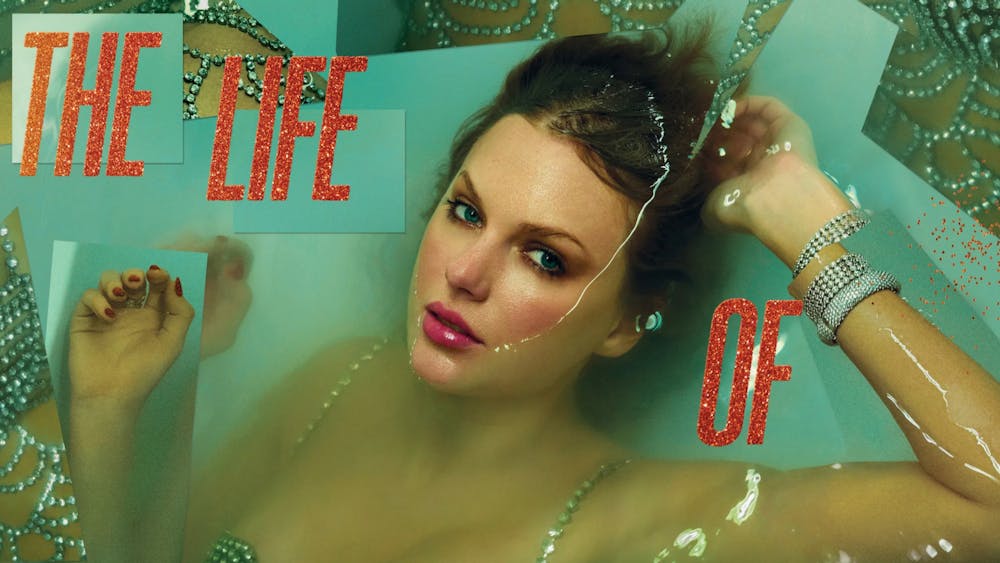
Ever since Taylor Swift released her 12th original studio album, The Life of a Showgirl, I can’t count the number of texts I’ve gotten from people I barely speak to asking how I’m doing after listening to the album as if somebody died.
Maybe something kind of did. Ever since Swift announced the album on her fiancé Travis Kelce’s football podcast—of all the places to announce one’s record—I’ve had a bad feeling about it. If the lyrics of select tracks on her previous release, The Tortured Poets Department, such as “You know how to ball / I know Aristotle” and “Touch me while your bros play Grand Theft Auto” from the prophetic “So High School,” were any hint of Swift’s lyrical decline, then we should’ve known what we were in for during this era.
I’ll be the first to admit that I treat Swift’s music like gospel. I’ve built rituals around every release: staying up for the midnight drops, wearing my cardigans and merch on release days, and attempting to memorize every lyric in record time. Over these past five days, I’ve realized that I’ve been trying to replicate the quasi–spiritual rush I felt when I first hit play on “Maroon” from Midnights with this new album. Unfortunately, The Life of a Showgirl doesn’t reach that height, or even aim for it.
Sonically, this is a stunning record. The production is polished, crisp, and clean. It’s filled with bold drums and shimmering instrumentals that resemble the best of 1989 and Reputation. Max Martin and Shellback, who produced the album along with Swift, know exactly how to make her voice glide over a sleek, radio–ready beat. “The Fate of Ophelia” and “Opalite” are glistening and expensive. “Opalite” especially feels engineered to play on repeat, with its “Oh, oh, oh, oh” hook that is just so unexplainably sing–alongable. After the first half hour, you can almost trick yourself into thinking Swift has finally, finally locked the doors to her cottage in the forest and is stepping into the light, heading back to her pop throne.
But then you start listening to the words.
Swift has always been her own greatest storyteller, but the stories in Showgirl feel unfinished. Unlike Folklore and Evermore, with their fully realized fictional narratives, it’s unclear what kind of tale she’s trying to spin here. The lyrics gesture toward intimacy without actually revealing anything, like she’s performing honesty instead of feeling it. She says the same thing she’s always been saying about love, loss, and dealing with fame. It feels formulaic: a few lines about men who’ve wronged her (“All the right guys promised they’d stay / Under bright lights, they withered away”), a few about how hard it is to be famous (“Oftentimes it doesn’t feel so glamorous to be me” and “You don’t know the life of a showgirl”), and a few about how her love saves her in the end.
The most popular critique amongst Swifties and non–Swifties alike has been that her lyricism suffers the fate of being too cringey and too “in–the–moment.” Showgirl’s “Track Five,” which Swift has dubbed as the most emotional song on every album since her eponymous debut, is “Eldest Daughter,” and it’s the most disappointing example of this trend: “‘Cause I’m not a bad bitch / and this isn’t savage,” she sings in the chorus. The line might’ve worked as a tongue–in–cheek moment five years ago—if that—but now it feels dated. She’s trying too hard to allude to an internet culture that’s already moved on.
Swift seems to fall victim to this multiple times in Showgirl. “Did you girlboss too close to the sun?” she screeches in “Cancelled!” over dark, Reputation–reminiscent production that can’t save the clunky phrasing. Elsewhere, on “Eldest Daughter,” she desperately attempts for poignancy with “Every eldest daughter was the first lamb to the slaughter / So we all dressed up as wolves and we looked fire.” The first half almost works: it’s raw and self–aware—until it collapses under a phrase that instantly drains the line of any emotion the metaphor built, reading like something a high schooler would’ve written on their AP English Literature essay with five minutes left on the clock.
A lot of this record feels like an attempt to flaunt her relationship with Kelce. The songs that nod to him constantly feel as if she’s overcompensating for the privacy of her seven–year–long relationship with Joe Alwyn—back when Swifties were kept in the dark and learned to read between the lines. Now she’s telling us everything, and it turns out, we don’t want to hear it all! We don’t need to know about his “redwood tree,” his “hard rock,” or how his “love was the key that opened [her] thighs.” The overexposure flattens the romance, and feels incredibly surface–level. Swift has always been sharpest when writing about what she can’t have. With Kelce, she finally has it, and she doesn’t know what to do with that. Swift needs to internalize the fact that Kelce is just a bad muse, and that’s okay.
All said and done, though, it’s hard to pretend that this album hasn’t been on repeat since midnight on Oct. 3. For all its lyrical flaws, Showgirl is still a Taylor Swift album—which means that even when the lyrics make you wince, she still finds a way to pull you right back in.
“Ruin the Friendship” is the song that redeems the album. It’s the sixth track on the record, and it feels like a time machine: a return to the kind of storytelling that first made people care about her music. Supposedly written about her high school crush who passed away, the song captures regret with the same immediacy Red once did over a decade ago, and it brings forth the ache of wanting to undo hesitation even when it’s too late. The imagery is pure old–school Swift, and the verse–by–verse narration calls back to the storytelling that made her relatable all those years ago. From the first listen, it felt like a song you’d play while walking home from school with Red buzzing in your headphones. “Ruin the Friendship” is the first moment on the album that proves that when Swift stops trying to prove something, she can still write a song that wrecks you.
“Father Figure” is another standout. With drums marching almost militaristically, Swift shows that she can still play around with her mythmaking and make it work. It’s one of the few songs on Showgirl where she fully commits to character, embodying a power–hungry mentor whose love curdles into control. She gets a bit absurd on this song, with lyrics like “I can make deals with the devil because my dick’s bigger.” Swift weaponizes camp with the same instinct that made “Blank Space” and “Look What You Made Me Do” so addictive. The production is cinematic, building toward a key change that hits like a plot twist that feels both sudden and earned.
Since the album’s release—and after sending death threats to anyone who dares utter one negative word about it—Swifties have been trying to convince themselves they love The Life of a Showgirl the way they’ve loved every Swift album before it. And I’m sure they do—but not without their reservations. This record is not the reinvention Swift thinks it is, but it’s also not the hot mess people make it out to be. It’s an imperfect album, sure, but by an artist who’s earned her right to stumble in public.
This album may frustrate Swifties, but it may also frustrate Swift herself: she’s trying to figure out what comes after happily ever after, and she hasn’t found the language for that yet. We can laugh at the clunky lyrics, cringe at her trying to fit in Gen–Z slang wherever she can, and still feel the same flutter we always do when one of her bridges builds or choruses change keys. Showgirl isn’t perfect, and it doesn’t have to be. After all, millions of us still have it on repeat—proof that even when Swift misses the mark, she can still keep us watching her show.