I need you to think of someone who is killing it in pop right now. Take a second—notice how you didn’t think of a man? For the past two years, women have been taking the pop genre by storm. Sabrina Carpenter, Tate McRae, Chappell Roan, Charli xcx, Taylor Swift—female artists have led the charge in bringing the excitement and energy the genre is known for. While it’s good to see women at the top of the music industry, it does beg the question: What ever happened to male pop stars?
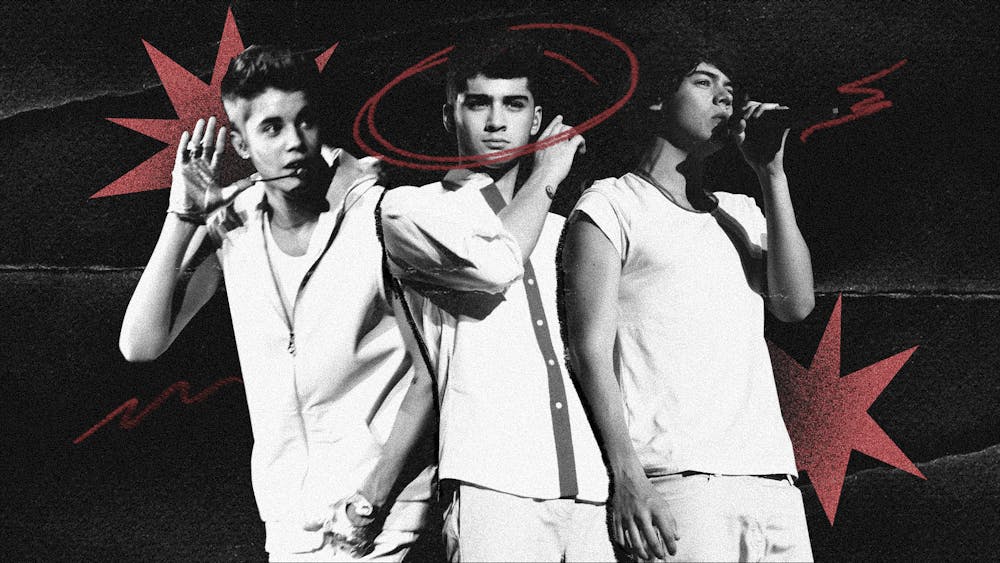
In the 2000s and 2010s, there were so many men crushing it across the pop landscape, from boy bands like NSYNC and One Direction to solo artists like Justin Bieber and Bruno Mars. Over the past 20 years, we have had plenty of generation–defining pop performances from men. Harry Styles might have had a brief stint in the spotlight after he departed from One Direction, but even he’s pivoted toward a softer, more introspective sound. There are certainly still men out there making pop music, but they just aren’t 2012 Justin Bieber. In fact, what it means to be a man in the pop sphere seems to have changed drastically, and the nuances of the male popstar archetype are experiencing a massive overhaul. So is the male pop star as we once knew and loved him dead?
To figure that out, we first have to understand what the traditional male popstar even was, and how that figure stood apart from other men in the music industry. The most prominent men in pop—Michael Jackson, Justin Timberlake, early–era Beiber—all shared a larger–than–life quality defined by performance: They sang, they danced, they smiled on cue. In the past, male pop stars were expected not only to deliver flawless vocals and execute elaborate choreography, but to sell a fantasy. Young male pop stars were marketed squarely to teenage girls—the same fans who, back in 2013, flooded One Direction stan Twitter with “imagines” and fan edits in hopes of being noticed by their favorite band members.
Labels built an entire business model around this kind of icon. Male pop stars were marketed as heartthrobs for teenage girls—perfect but approachable, flirty but safe. Think of Justin Bieber’s “One Less Lonely Girl,” or “Boyfriend”—songs that paint Justin Bieber as the perfect guy, here to treat you the way you deserve. Those at the top of those charts today—artists like Drake, The Weeknd, and Future—make hugely popular music, but the way they present themselves departs from the typical “pop star” template. Their personas lean into bravado and detachment rather than choreography or polish. They’ve intentionally distanced themself from their labels, defining themselves as rappers or R&B artists instead.
Over time, the elements that once defined male pop stars have begun to fade. Fewer men in mainstream music dance, and fewer still build personas around performance. At the same time, a clear gender divide has emerged in how audiences listen—increasingly, women are making songs for women and men are making songs for men. The genres most popular amongst men—country music and hip–hop/rap—remain largely male–dominated, whereas pop has become increasingly female–led. It makes sense: People want to hear voices similar to their own.
Pop itself has changed, too. Hyper–pop and indie–pop have become more mainstream, replacing the bubble–gum, cookie–cutter pop music of years past. If there is no true set pop sound anymore, it's more difficult to pinpoint who is even making pop music, let alone whether they're a star of the genre.
The male pop star of years past may be gone—buried somewhere in our massive pop–culture landfill—but there is a new generation of emerging talents who have redefined what it means to hold that title today. This new generation trades swagger for vulnerability, employing tactics commonly used by the likes of Taylor Swift and Olivia Rodrigo. Instead of promising perfect romance, male pop stars are starting to embrace relatability, introspection, and authenticity—just like most female pop acts have been doing for ages. Dare I say it? The new male pop star might just be a woman.
Sombr, for example, has risen in popularity recently due to the virality of his songs, like “back to friends” and “undressed.” While he may not make the traditional upbeat pop of his predecessors, he still has a strong branding strategy that appeals to female audiences: not promises of perfect romance and polished imagery, but introspection and yearning. Unsurprisingly, vulnerability and unaccountability seem to resonate deeply with a lot of young women. ROLE MODEL takes a similar approach to pop stardom, unafraid to embrace his imperfections and address the way he feels. His most popular songs, “Sally, When The Wine Runs Out” and “Some Protector,” address his insecurities and his fear of not being enough—a total shift from the male pop music of the past, which presented men as heroes or dream boys.
Then there’s Troye Sivan, a veteran in the genre, who still embodies classic pop–star showmanship—elaborate performances, choreography, charisma—but does so through a queer lens. His hits “Rush” and “Got Me Started” are a kind of reimagining. Conan Gray follows the same pattern, with catchy, upbeat songs that are true to his experiences and explore similar themes.
Each of these men approach pop differently, but they’re all succeeding for the same reason. In contrast to the pop idols of the past, they seem to lean a little more into authenticity, eschewing the persona of the over–choreographed, larger–than–life performers told what to do by their labels. The male popstar might not be entirely dead. Sure, the choreography’s gone, the fantasy’s faded, but the spotlight is still there—maybe now it just shines on something a little more real.