What do Billie Eilish and the Bush administration have in common? An intimate knowledge of shock and awe.
The musician’s Oct. 23 show at the XFinity Mobile Arena begins with a bang—many bangs, to be more precise. An iridescent cube in the center of the stage whirs and pulsates with an insidious mechanical energy, filling the Philadelphia Flyers stadium with a sense of dark anticipation. It is the second Philadelphia show of Hit Me Hard and Soft: The Tour—though from the crowd’s reaction, you would think it's her first public appearance in years. “We love you, Billie!” and numerous less–intelligible, but equally enthusiastic shouts fill the arena as Eilish tears into the opening lines of “CHIHIRO,” making the actual performance nearly impossible to hear. What is clear, however, is that this is a near–religious experience for everyone here—Eilish’s powerful stage presence and transcendent vocal performance only reinforces the crowd’s manic energy.
The concert is undoubtedly a “girls and their boyfriends” kind of show—it's evident from the Jumbotron’s brief scan over the crowd at the barricades, where the women scream and wave eagerly at the camera and the men, stone–faced, offer little more than a head nod and upside–down peace sign. The energy of the crowd as a whole, however, has been at a fever pitch from the moment the show began. Bandanas, snapbacks, and baseball jerseys abounded, all referencing Eilish’s signature sense of style. These are Eilish’s people—and she knows it.
The show’s emphasis on special effects only fans the flames of the crowd’s passions. From soundscaping to visuals, the show is an absolute masterclass in stage design, every moment perfectly tailored to support the music’s emotional highs and lows. During the most dramatic moments, massive columns of fire burst out of the stage, letting Eilish bask in their hot, orange glow. Water, on the other hand, is a consistent motif during softer tracks: Three massive screens over the stage ripple with crashing waves, octopi, and sharks as Eilish’s dulcet tones wash over the crowd.
Despite the arena setting, Eilish and her team work hard to create a sense of intimacy among attendees. She sprinkles audience interaction liberally throughout her performance, from brief energy checks (“How are y’all feeling today?”) to more elaborate calls, inviting us to crouch down, jump up, and turn our phone flashlights on. During “when the party’s over,” Eilish asks the audience for complete silence as she records her layered harmonies live, a move that leaves ample room for her soft vocalizations to fill the space. Of course, a few die–hard fans can't help but take this opportunity to shout “I love you!” into the mix, their voices lingering in the harmony. On “bad guy,” Eilish picks up a handheld camera and holds it close to her face as she emotes throughout the song, emulating the feel of an impromptu Instagram Live. Not all of these bits land successfully—in one awkward interlude, Eilish begins spewing vaguely political platitudes about the “scary” state of the world, alluding to horrors unfolding across the globe while refusing to mention anything (or, perhaps more damningly, anyone) by name. Still, the show maintains a remarkable coexistence of big–energy theatrics and small–show closeness throughout its nearly 90–minute runtime.
Eilish’s setlist is full of big tonal swings, putting the full breadth of her catalog on display, from high–energy bangers like Charli xcx’s “Guess featuring billie eilish” to sad–girl classics like “What Was I Made For?” Some transitions feel natural and weirdly smooth—others, like the shift from “bad guy” to “THE GREATEST,” are a bit more jarring. Through it all, of course, Eilish is able to flex her vocal chops to the fullest, getting soft and emotional one moment, but loud and balladeering the next.
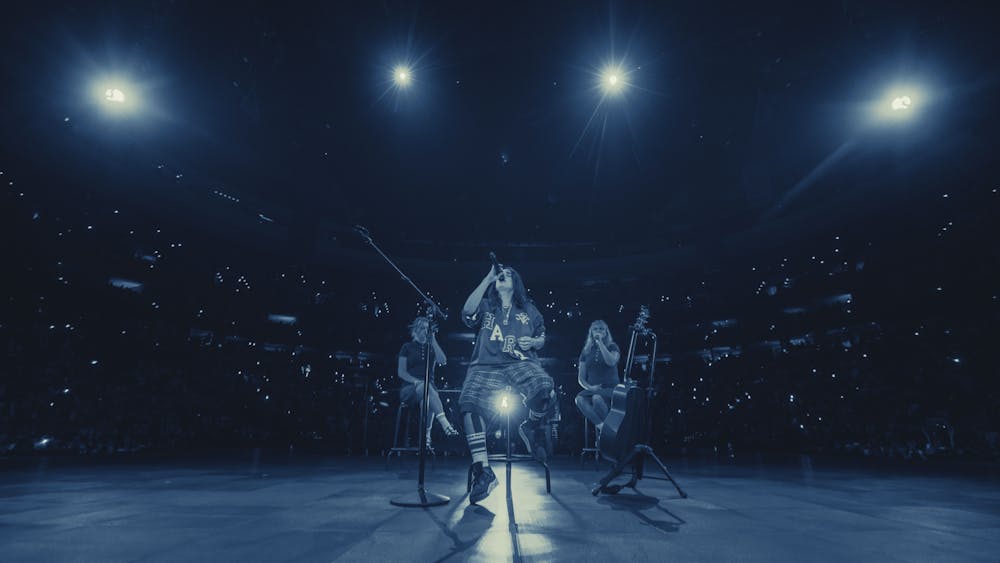
While the special effects add to her performance, Eilish’s electric stage presence is what truly makes the concert great. Riding the wave of sonic energy that filled the arena, Eilish navigates the full length of the stage on each song and highlights the efforts of her backing band throughout her performance. Most importantly, she knows how to get loud and how to get quiet—in a particularly touching and intimate section of the show, Eilish brings out an acoustic guitar and sings a couple of songs alongside her two backup vocalists, who support her robust voice perfectly.
The show’s best moments, however, are those the crowd anticipates least. Towards the end of the concert, Eilish performs a stunning rendition of the early 20th–century standard “I’m In The Mood For Love.” For only the second time tonight, the crowd falls almost entirely silent as Eilish’s stunning voice permeates the room, putting her full talents on display. The intimacy of the ballad is haunting, beautiful, and sums up the message of her entire show: Though thousands are in attendance, Billie is speaking to you.