At Lucien E. Blackwell West Philadelphia Regional Library, Max VanCooper is connecting neighbors in West Philadelphia through craft. West Philly Skill Share, an eight–part community arts series, invites participants to learn a new hands–on skill taught by a fellow community member while also meeting others from around the neighborhood.
“The idea was to create something that feels accessible,” VanCooper says. “There are a lot of amazing community members with so many different skills to offer.” So far, the series has included workshops on Urban Beekeeping, Resisting Burnout, Sashiko Mending, and Honeycomb Shelf–Making, all aimed at giving the community an opportunity to try new crafts. “People were chatting, getting to know each other, meeting strangers, and for me, that’s exactly what these workshops are for.”
Outside funding, secured through a local arts grant, allows VanCooper to keep the program free for participants and compensate the artist for their time. Accessibility has remained a key part of the skill share mission. Skills that wouldn’t normally be accessible to many are now shared across the community. The program invites people from all walks of life: college students, retirees, parents with small children, and any Philly resident with a desire to learn. Some participants shared that the familiar atmosphere of the workshops played a role in their comfort. The library’s identity as a public space carries over into the creative space; everyone belongs by default.
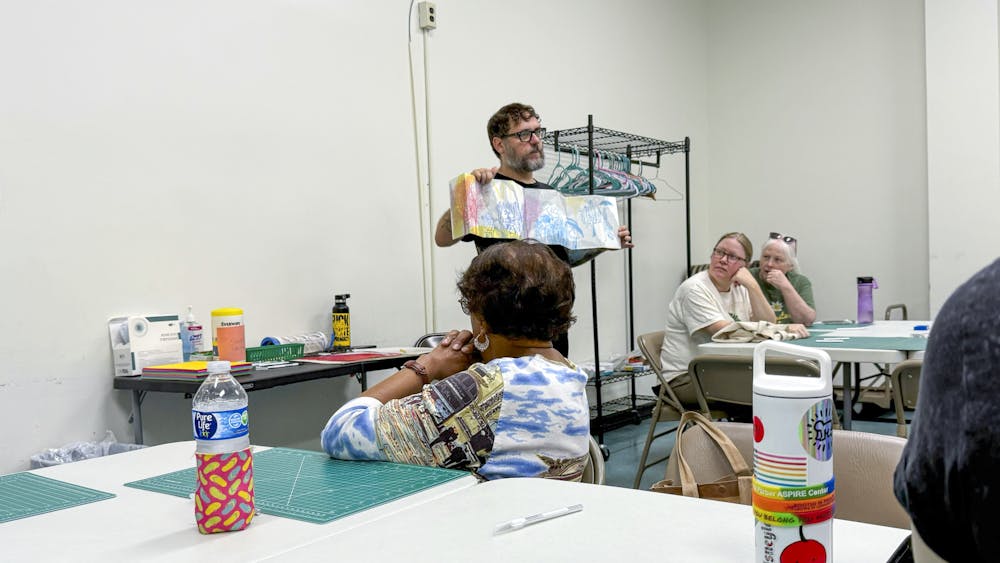
The seventh course of this series is led by local artist Erik Ruin. He sets up a platform at the front of the room and guides the attendees through the art form of paper cutting. Tables are covered with blades, bright green cutting mats, and colored scraps of paper as Ruin demonstrates the precision and patience needed for the craft. With a background in both graffiti art and stencil work, Ruin has spent over two decades exploring ways to manipulate lines and shadows.
“Paper cutting is economical in both senses,” Ruin said. “For me, it’s a really economical way to create art … It’s simple. It’s either there’s paper [or] there’s not paper, on any given surface.”
A few basic tools can open the door for endless creation.
“You can learn the basics in an afternoon, right? But you could spend the rest of your life perfecting and complicating those things," Ruin adds. "And then also, I would say it’s economical in the sense that it’s affordable … You need a five–dollar knife, maybe a twenty–dollar pack of blades … Paper is super cheap.”
Before participants began cutting, Ruin spends a half–hour demonstrating proper technique. He goes over how to hold the blade, trace outlines, show positive and negative space, and carve details without tearing the paper. He also shows off several of his own works from the last several years. The atmosphere is very low–key, and the attendees are able to interject at any point with questions.
“I live in the neighborhood. My friend told me about it. And I haven’t taken an art class in a really long time, so I was excited to do something that was free and to learn a skill that I really know nothing about,” says Maria Adamson, who lives in the neighborhood. “Just looking at the teaching artist’s examples of his work is just incredible … [It's] really inspiring just to see the talent of people who are part of the community.”
Her experience shows how the workshop encouraged participants to be curious and try something new: “I just learned, in trying to do my paper cutting, how to see what to cut differently,” she adds. “It’s fun, even though I don’t have any intention of pursuing this in a serious way, just to have the opportunity to see the world through a different visual lens.”
The workshops are as much about conversation as they are about crafts. Participants often find a group of people to sit with, then share stories and converse while they learn and create.
Someone asks, “How did you make your detail so sharp?” and the response launches a discussion about technique or approach. One participant shares how they’re trying to carve a miniature portrait of their recently deceased cat. Another speaks about attempting a symbol tied to their identity (which they had struggled with for years) and how shaping it on paper felt challenging and strangely healing. These informal exchanges are just as valuable as the skills being taught and often lead to mutual encouragement and reflection. The skill share encourages connection beyond its classes, as participants often exchange contact information to keep in touch.
Dyresha Harris, another attendee, said she discovered this event through the Urban Art Gallery’s summer art festival. “The library had a table with some of the things they were offering, and I’ve always been interested in paper cutting. I really like the model of getting to learn from folks in the neighborhood and share skills,” she says. “I think we have a lot of resource[s] here … It promotes pride and investment in the neighborhood. I have something I can share, you have something you can share. It’s kind of like mental mutual aid.”
The phrase “mental mutual aid” perfectly captures the essence of what the skill share stands for. West Philly has long been known for its do–it–yourself culture, and the skill share fits neatly into that landscape, contributing to a legacy of creativity and collaboration.