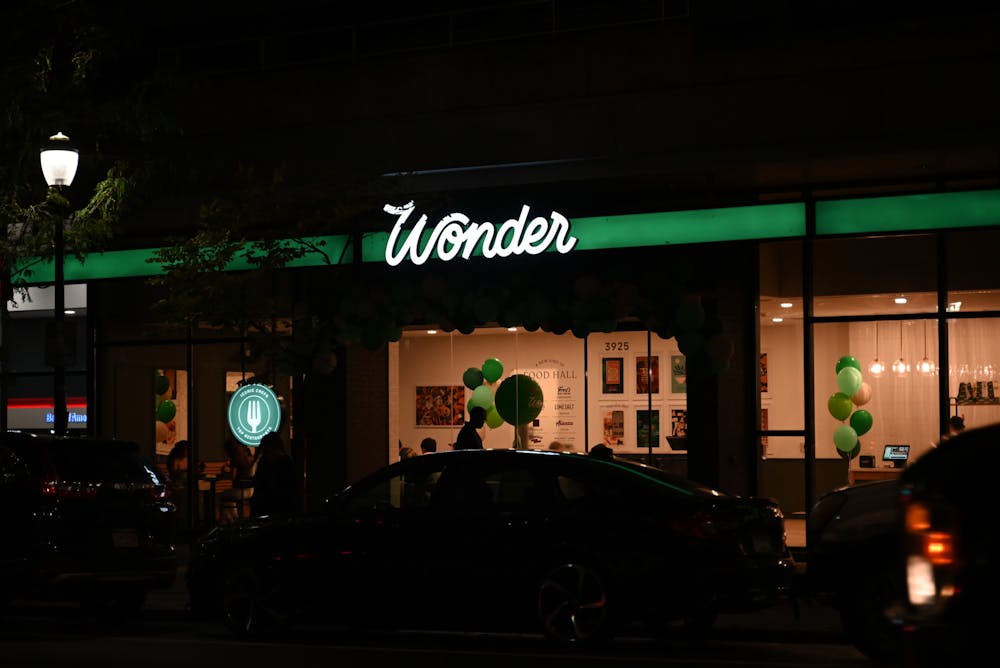
While we were away from Penn for the summer, a Wonder food hall was setting up shop across the street. It opened this past September on Walnut Street, nestled between a Sweetgreen and a Bank of America. The storefront features eight meager white tables, clustered to the left–hand side. The remaining area is effectively a waiting room, featuring a long, lonely expanse of vinyl wood planks. This view is interrupted only by a pair of five–tier shelves for delivery and pickup orders and two counters, where you can order your food from a tablet while discussing your options with a green–aproned staff member. The kitchen is out of sight, out of mind.
Wonder arrived on the Philly scene this past spring, given some extra oomph by a $600 million fundraising round in May. Its value proposition is clear: By acquiring various restaurants and recipes, Wonder functions as an all–in–one food hall, preparing dozens of cuisines in a single kitchen. In all, Wonder has raised over $2 billion and recently established five “food halls” in Philly—joining its existing fleet of 73 nationwide. It promises convenience, and it literally delivers. The negative reception Wonder has received, however, feels less about its food and more about its values.
This fall, Wonder has become nearly inescapable. Its carefully curated advertisements have appeared on SEPTA stations, bike stands, and every major social media platform, thanks to its acquisition of the food media company Tastemade. If you live in the Philly area and own a phone, you’ve no doubt seen its ads, with one especially prolific flyer boasting about its “0 Delivery Fees.” (The big fat zero is made of food, with versions including Mediterranean salad, pepperoni pizza, salmon poke, hard–shell taco, and hummus dip.)
In addition to its fairly prolific Instagram page, Wonder has enlisted a legion of food and lifestyle influencers to make content about their dining experiences. They go like this: “You know when you’re hungry for literally everything, but you can’t decide what to get?” or “[my sister] and I can never agree on what to eat.” With the familiar mealtime indecisiveness established, the creator brings a Wonder meal on screen, praising the food hall for satisfying even the toughest customers with its quality, range of cuisines, and of course, zero delivery fees.
Its biggest selling point, however, has to be the promotional deals. While Wonder’s prices match standard restaurant fare (entrees ranging from just over $10 to almost $40) the company is willing to offer some pretty generous promos. These include $15 or 50% off your first two orders and an additional $15 of credit each time you refer a friend.
“A lot of people had the incentive to go because [of] that discount for the first two orders,” Angelie Rodriguez (C ’27) says. “People were getting every meal, like, $10 or down.” She’s a frequent customer and tried the food when Wonder opened its first brick–and–mortar locations in her home state of New York. Since then, she’s become somewhat of a Wonder loyalist, getting its food about three times a week.
In many ways, Angelie is Wonder’s ideal customer—the exact type of college student the company hopes to entice. “I’m lazy, so I don’t cook,” she says with a self–deprecating chuckle. “In previous years, I would get dining hall food … so [Wonder] came at a good time when I was getting tired from not only Penn food, but also the off–campus dining options that I was eating on rotate.”
It’s not hard to imagine this story repeating itself across much of the student body. A stroll around campus at 8–or–9 p.m. (Wonder stays open until 11:30 p.m.) generally confirms as much. People–watch in the high rise fields or peer through Wonder’s glass facade, and you’re sure to see students or delivery motorcyclists toting those ubiquitous white–and–green bags.
“Oh my god, no, not Wonder!” Angelie’s friends exclaim when she went to pick up her order one Saturday night. “That damn AI kitchen!”
It’s okay, though—Angelie understands. “I think what weirds people out, to be honest, is the way [the storefront] looks. You go in, and it’s just like a bunch of white open space, two kiosks, and then a couple of chairs and tables to the left side, and it’s like, ‘what the hell is happening right now?’”
Wonder doesn’t use artificial intelligence in its kitchens, but there’s something to that “AI kitchen” sentiment. Like a poorly made chatbot, its marketing sometimes wanders into the uncanny valley. Wonder almost seems like a living, breathing multi–restaurant, delivery, media conglomerate, but always a bit too hard, shiny, and opaque. An A–frame stationed outside its University City location entices passersby with food–porn graphics, which Wonder has mastered by now, but the text above simply reads “WE’RE OPEN / COME INSIDE / IF YOU’RE HUNGRY.”
“I think [Wonder] is taking away the art of cooking,” Maggie Miller (E ’26), photo editor of Penn Appétit, says. In her experience as a line cook and a cake–maker, she has found the labor itself to be vital for the cooking process. “Most restaurants put a lot of work into their food … a lot of effort from the chef, from the cooks, and from the servers.”
Wonder, on the other hand, is in no rush to show you how the sausage gets made. The facilities are kept tidy, with countertops clean enough to eat off of—but if there are no sit–down customers at the moment (as is often the case) you’d be hard–pressed to find any food in sight. “If there were no signs, or if there were no words,” Maggie says, “I would have no idea that [Wonder] is a place to get food.” Peer around the counter at its Penn location, and you can only see a small, empty corner of the kitchen. There are no ingredients or appliances in sight; workers emerge with your meal bagged and ready to go.
Indeed, there’s no cooking process quite like Wonder’s—it wants to be the whole enchilada, the spring roll, and the cannoli too. Despite handling so many cuisines, the business manages to be “vertically integrated,” meaning Wonder sources its own ingredients, prepares food in its own facilities, and, especially after its acquisition of GrubHub and Blue Apron, makes all of its own deliveries.
In fact, Wonder has invested “millions of dollars” into research and development to make a one kitchen, 27–restaurant system that pumps out food to scale and speed, while trying to maintain quality. Its steaks, for example, are all sous vide (vacuum–sealed and cooked in a hot water bath) during the preparation process, a method which is supposed to maintain the meat’s quality throughout storage while keeping the final cook brief. The company’s CEO, Marc Lore, brags that Wonder “can cook that Bobby Flay steak in six minutes … pizza in 90 seconds, pasta without water, stir–fry without a wok.” There are no flames in a Wonder kitchen; the company cooks 560 unique meals with two pieces of “proprietary electric cooking technology.”
The aforementioned Flay heads up a vanguard of celebrity chefs that have licensed their recipes and brand images to Wonder, hoping to bring their food to locations they could otherwise not reach. Joining Flay are José Andrés, Marc Murphy, and many more.
The chefs seem eager and excited about this partnership. Andrés has joined Wonder’s board of directors, and Bobby Flay’s website includes a glowing endorsement of the company. “Having Bobby Flay Steak available ‘just around the corner’ has always been my dream,” Flay’s website reads. He’s convinced that “Wonder guarantees top–notch quality every time.”
Reception on the ground has been more mixed; predictably, Angelie and Maggie belong to opposing camps. “The pasta I ate yesterday was definitely something I would probably get at a restaurant,” Angelie says. “I guess if you consider the fact that it was 20 bucks [this] makes sense. … I would say in that case, the quality does match up with the price.”
On the other hand, when Maggie first received the voucher for Wonder and went to try it out, she was “quite disappointed” with her meal. “I ordered the chicken wings, and I think they were glorified chicken nuggets” she says. Moreover, she believes that “if a restaurant wants to expand, it should expand within the realm of the people nearby that they can feed. I don’t think they should be mass producing food to freeze and ship—I think it should be for their own community.”
If Lore has heard any of these negative reviews, he remains undeterred. “I started Wonder because I saw a massive opportunity to completely reimagine mealtime,” Lore says in a written interview. “For most people, delivery is a compromise. The food’s cold, it’s late, and it simply just doesn’t taste the way it would in a restaurant. I thought, what if we could bring the best of the restaurant experience right to people’s doors, hot and perfectly cooked, every time?” And thus began Lore’s over–$7–billion idea.
In reality, Lore was already a billionaire by the time Wonder originally opened as a food truck concept in 2021. Lore founded diapers.com in the mid–aughts and grew it into a nationwide service. After its sale to Amazon in 2010, Lore went on to found jet.com and lead Walmart’s e–commerce branch.
Since leaving Walmart in 2021, the electronic merchant extraordinaire has sought to build the future. Lore assumed leadership of Wonder Group only after backing a streak of highly ambitious ventures, including a nuclear fusion startup, a flying taxi service, and a utopian city in the American West.
If these other New Age enterprises make Wonder’s multi–restaurant food halls seem more run–of–the–mill by comparison, don’t fear—Lore’s ambitions are expansive and, unsurprisingly, AI–driven.
“About 90% of my meals are all AI–derived,” says Lore. “So AI tells me what to eat for breakfast, lunch, and dinner.” (That morning, he’d been told to eat oatmeal.)
This is Wonder’s next frontier of vertical integration: consumers themselves. Lore hopes to launch an “AI–based platform wrapper” to deliver restaurant dishes, meal kits, and groceries directly to your home, or even make a restaurant reservation on your behalf. The model will keep your health goals, meal preferences, and budget in mind to administer you three meals a day.
Wonder is trying to spearhead this new age of eating because, as Lore puts it, “The world is changing too fast to stand still.” In fact, he came to Penn’s Venture Lab this past September to tell students as much.
“I talked about the importance of having a big vision, surrounding yourself with great people, and being willing to take smart risks, even when the outcome isn’t guaranteed,” Lore says. The last point is especially important to him, and Wonder represents the latest step he thinks society must take. “[Wonder] felt ambitious, even risky, on paper,” Lore admits. “But to me, the bigger risk was letting the current food delivery model persist.”
From this vantage point, Wonder’s future seems as dazzling as it is inevitable. On campus, however, the issue remains whether it will earn a place in the Penn bubble and, indeed, whether they should.
Importantly, criticism of Wonder doesn’t seem to come from the food alone. The average Penn palate isn’t exactly discerning, and from Commons to McDonald’s to Chipotle Mexican Grill, our current food halls are far from hallowed. The Walnut Street eateries that share a block with Wonder often don’t prepare their food fresh, are arguably disconnected from the cuisines they serve, and appeal to the same grab–and–go customers that Wonder tries to capture.
These restaurants, however, fail to stir up the same drama. “Going to Chipotle, they have various things on the menu, but they’re still focused on one type of food. I think because Wonder does so many different types of food, it feels disconnected, and it feels like you’re walking into a mall’s food court but minus all the people” says Maggie.
Indeed, Wonder is far from the spunky setting of a food court like Franklin’s Table. One cannot hear shouted commands, smell clashing aromas, or see the cooks hustling in the back. Without this motley charm, Wonder’s wide variety comes across as purely utilitarian, and its advertisements feel smothering.
This impersonal, business–first ethos seems to be the sticking point for potential customers—Wonder is making a bet that we will prioritize convenience over culture. As Maggie puts it, food in its most fundamental form is “something that someone who loves you is preparing for you.” From its pared–down cooking process to its AI breakfast oatmeal, Wonder is willing to innovate that love away.
Correction: This article has been updated to reflect that Wonder closes at 11:30 p.m. and that Wonder originally began as a food truck concept in 2021. Street regrets these errors.