
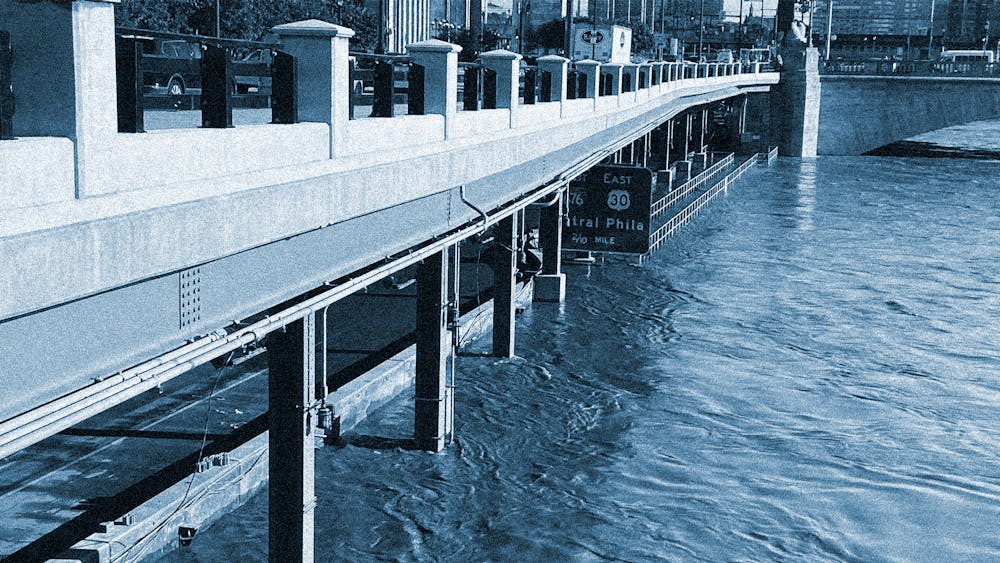
Located in Southwest Philadelphia, the neighborhood of Eastwick rests on marshland 11 feet below the Delaware River. Residents face a unique predicament when the first drops of an approaching storm paint the sidewalk: As water swells from Darby and Cobbs Creeks and combines with rushes from the Delaware and Schuylkill Rivers, Eastwick is flooded with up to five and a half feet of water. Just miles from the bustling streets of Center City, the neighborhood sits at the crossroads of an intense flooding crisis that will only worsen amidst a shifting global climate and insufficient governmental action.
In April 2025, a million–dollar grant from the Environmental Protection Agency to Philadelphia was terminated with little warning, an action that stands in stark contrast to the environmental justice initiatives undertaken during the Biden–Harris administration. The funding, which aimed at addressing the flooding in Eastwick and a variety of other environmental concerns, was long overdue. After the grant was canceled, funding for temporary flood barriers was halted and placed under review, and Delaware County grants for a levee project to mitigate flooding in similar regions were also cut.
In response to such actions, local residents, led by Pennsylvania State Senator Anthony Williams (D-8), took to Washington and their representatives in Congress in an attempt to fight back against the actions of the Trump administration. Neighbors deal with feelings of abandonment and lingering questions about what the future holds, which become more pressing every time the forecast predicts rain. Community organizations like Eastwick United CDC and Eastwick Friends & Neighbors Coalition are dedicated to raising awareness and tackling the issue. Additionally, research involving the Army Corps of Engineers is looking into practical solutions for the neighborhood's chronic flooding—but much work remains to be done.
From uncontrolled mold to contaminated water, the health implications of the flooding have had many adverse effects on Eastwick’s residents. “When water comes into your home [and] stays for more than 48 to 72 hours, you can reasonably expect that there will be mold occurring on surfaces like walls and floors, but also behind the walls,” says Marilyn Howarth, director of the Community Outreach and Engagement Core at the Center of Excellence in Environmental Toxicology. Porous materials such as wood have to be replaced. As flooring, walls, furniture, and utilities like furnaces and water heaters all get damaged, the material costs that come with flooding are immense.
“For people who live in Eastwick, which is really a working–class to middle–class neighborhood, some people cannot afford the $5,000 to $10,000 a year that flood insurance costs. And although that may not sound like an exorbitant amount of money, it’s all relative,” Howarth says. “Financial devastation really does have health implications.” With choices about which medications to purchase, which treatments to undergo, whether to pay a visit to emergency departments or clinics, working–class residents face an array of serious healthcare decisions that are made more difficult by their financial situations.
“Another thing is the mental health implications,” adds Adrian Wood, CEET’s program coordinator. “Community members have said to us before … every time it rains, [they] feel very anxious and worried that it’s going to be this devastating flood even though it might just be, you know, a small rainstorm.” The struggles caused by Eastwick’s flooding are multidimensional and difficult to alleviate with a single proposal or policy.
Eastwick is also surrounded by hazardous landfills containing high levels of heavy metals, polychlorinated biphenyls, and polycyclic aromatic hydrocarbons. When residents are exposed to these chemicals during floods or post–flood cleanups, they risk a wide array of health problems, from neurological and reproductive damage to an increased risk of cancer, cardiovascular disease, and even developmental impairment in infants. In addition, prolonged exposure to mold in living spaces can exacerbate respiratory conditions such as asthma and predispose vulnerable populations to further disease and illness. “People who are on chemotherapy or have immune deficiencies for other reasons are actually at risk of becoming infected with some of the fungi that can find their way into moldy premises,” Howarth says. The ramifications of Eastwick’s environmental conditions extend well beyond the visible signs of water damage.
The fate of neighborhoods like Eastwick remains uncertain in light of recent developments in federal policy. The Trump administration has continually dismantled climate and environmental justice initiatives, such as the Building Resilient Infrastructure and Communities program established in 2018. Citing reservations about the program’s overwhelming concern with climate change, the Trump administration has continually tried to destroy programs created by the Biden–Harris administration to equitably allocate government resources and spotlight underrepresented communities. Such action also highlights the difficulty of striking an effective balance between local and national interests.
One example of this challenge arose when residents urged the development of a functional warning system to send out alerts specifically to Eastwick. Because flooding often occurs several hours after the rain has stopped through a chain of other circumstances, the citywide warning system usually falls short. Evacuation plans, cleanup protocols, damage repair and control, financial literacy on insurance, and even advice or safety measures for the disabled are all imperative assets to community members who may find their lives upturned with a single shift in weather conditions.
While the trials and tribulations of Eastwick residents may last well into the future, it is comforting to know that some resources are in place to help those forced to navigate uncertainty. The Flood Preparation and Management Guild for Philadelphia, created by the Philadelphia Regional Center for Children’s Environmental Health as a collaborative effort with the University of Pennsylvania and the Children’s Hospital of Philadelphia, is one project attempting to relieve the burden on residents to fend for themselves in such life–altering situations.
Whether it is through the establishment of a task force of multiple agencies or a simple volunteer organization dedicated to highlighting community voices, true recovery must begin with collective action and resilient will. And as long as residents continue to fight for the future of Eastwick, their legacy will stand strong against the waves that may threaten to drown them out.