Guillermo del Toro has been in a 25–year situationship with Frankenstein. He’s said it himself: “Frankenstein to me is the pinnacle of everything … I dream I can make the greatest Frankenstein ever, but then if you make it, you've made it. Whether it's great or not, it's done. You cannot dream about it anymore. That’s the tragedy of a filmmaker.” It’s such a painfully romantic thing to admit—that the dream is sometimes sweeter than the execution, that creation always comes with the risk of disappointment, that once you animate the monster you lose the fantasy of what he could have been. It’s deeply Shelleyan, deeply Catholic in the melodramatic sense, and deeply del Toro: he's a man who loves monsters so tenderly he’s almost afraid to touch them.
What makes del Toro so uniquely suited to direct Mary Shelley’s creation myth is that he treats monsters the way she did—seriously, emotionally, as reflections rather than aberrations. Shelley’s novel was written by a literal teenager who had already lived more life and grief than most men double her age; she understood the violence of creation, the loneliness of genius, the unbearable intimacy between maker and made. And del Toro, who has spent the past three decades turning monsters into metaphors for childhood, for parenthood, for faith and exile and shame, finally gets to meet her on her own terrain.
It still kills me that the same woman who put Harley Quinn in hot pants in Suicide Squad is also the mind behind the costumes in Frankenstein. Kate Hawley has always been maximalist at heart; she just finally found a director who lets her lean into intelligence rather than spectacle. Hawley isn’t doing the lazy, sepia–washed “Victorian cosplay” that costume departments love. She and del Toro placed the film in the 1850s, which is such a fascinating transitional moment for clothing: the steel–cage crinoline has just arrived, industrial dye chemistry is exploding, Jacquard looms are flexing, and Europe is drowning in Crimean War anxieties.
Victor’s mother’s look is aggressively continental, almost Germanic, which is so much closer to Mary Shelley’s original Gothic than anything British. The black–and–white servant headdresses in her scenes nod to Prussian and Swiss regional dress, and suddenly you realize Hawley is not referencing Dickens at all; she's referencing Appenzell lace caps and Schwalm folk veils, those stiff, architectural shapes that sit somewhere between Catholic ritual and rural craft. Victor’s mother ends up dressed like a woman who lived on the exact hinge between aristocratic hauteur and the new machine age. Her silhouette is peak–1850s dome—perfectly circular, mathematically engineered—with the kind of crisp structural underpinnings that only became possible once steel replaced whalebone. She’s the embodiment of the old world trying to hold its spine while industrialization whispers right behind her shoulder.
Elizabeth (Dior It Girl Mia Goth) honestly might be one of the best–costumed Gothic heroines in years, and her green gown might be my single favorite costuming moment of the entire film. Rather than re–heating The Other Boleyn Girl’s nachos as most of historical costuming has done in recent years, the dress feels like it was made by a textile designer hallucinating on aniline dye fumes. The swirling malachite pattern is exactly the kind of Jacquard–woven fever dream that becomes possible after industrialization makes complex patterns cheap and fast. It’s geological, chemical, and slightly toxic–looking—as if the fabric itself has undergone Victor’s experiments. Her sleeves are this delicious hybrid between pagoda and bishop—historically impossible in pre–industrial fabrics, but totally plausible once chiffon–level sheerness becomes accessible. It’s the kind of choice that reminds the audience that Hawley is dressing a woman living in a world where science is mutating faster than culture can keep up. Her necklace—designed with Tiffany & Co.—is beyond camp. Hawley literally Frankenstein–ed the cross from Meta Overbeck’s scarab necklace and archival Tiffany devotional pieces. It’s Victorian devotional jewelry fused with 1890s Arts & Crafts metalwork, fused with del Toro’s favorite shade of carnelian blood–red. It’s religion and nature and metallurgy and grief in one object—basically the thesis of Mary Shelley’s whole life.
Del Toro’s version is so steeped in Catholic imagery you can practically smell the incense and generational guilt rising off the screen. It comes out strongest in the Pietà moment, where the Creature (Jacob Elordi) lifts Elizabeth in her wedding dress, her body limp and luminous in his arms, like del Toro finally admitting what Mary Shelley always knew: that creation is a theological act, and every act of creation has a corpse hiding somewhere behind it. It’s his most openly Catholic tableau in years, but it’s also one of his most tender—the monster carrying the woman he never harmed, the only person who ever looked at him without projecting someone else’s nightmare onto his face.
Victor (Oscar Isaac) keeps hallucinating what he calls an angel: a tall, burning red figure with wings like molten glass. But anyone that goes to mass would know it’s not an angel: it’s ambition, self–loathing, and unmitigated genius wearing the mask of divine permission. Angels do not glow red, and angels definitely do not seduce you into breaking natural law. Whatever Victor sees is closer to a demon or a delusion, the kind of spiritual mistake men make when they want God to sign off on their ego. Victor thinks he’s receiving divine inspiration when really, he’s just high on his own importance. It’s classic Victor behavior: misinterpreting everything, misrecognizing everyone, and projecting meaning onto whatever flatters him most.
And honestly, del Toro’s Victor is almost exactly the way I imagined him at fourteen when I first read the book: pathetic, manic, absolutely convinced he’s a visionary because he read two philosophers and no one has told him to shut up yet. This is a Victor who thinks Elizabeth—his baby brother’s literal fiancée—must be madly in love with him because she likes insects and natural philosophy. It’s exactly like 500 Days of Summer’s “Just because she likes the same bizarro crap you do doesn’t mean she’s your soulmate,” except somehow worse, because Victor takes this delusion and builds an entire yearning cosmology out of it. Victor Frankenstein is the prototype of the mediocre man who mistakes shared interests for divine romantic destiny.
It all fits perfectly with del Toro’s own confession about fatherhood: “I have become my father whilst trying to run away from the same mistakes … Fathers are a big shadow.” The film basically asks: What happens when you create life before you know what to do with your own? Victor fails the Creature the way absent fathers fail their sons: through vanity, fear, and a refusal to admit their own smallness.
Mia Goth delivers the line, “You can see God’s design in the symmetry and the shapes,” with such eerie conviction you almost buy into the possibility of divine order. But then she says, “To be lost and to be found is the lifespan of love,” and suddenly the whole film reframes itself. Creation is not a miracle; it’s a responsibility. Love isn’t symmetry; it’s accountability. And Victor, for all his genius, cannot comprehend either.
Del Toro also rewrites the ending completely. In Shelley’s novel, the Creature leaps into the Arctic darkness carrying Victor’s body, vowing self–immolation, as if the two of them are locked in a cosmic pas de deux for eternity. Instead, Del Toro’s Victor dies, the Creature doesn’t martyr himself, and the final image is him walking alone across the Arctic with no promise of closure, no guarantee of redemption, and no clear direction. It’s beautifully open–ended, which is unprecedented for an adaptation that normally treats the Arctic as a graveyard. The tragedy shifts: the story stops being about a monster who dies for his maker, and becomes a story about someone who outlives the man who ruined him. The ambiguity is the entire point—del Toro trusts the Creature to write his own ending.
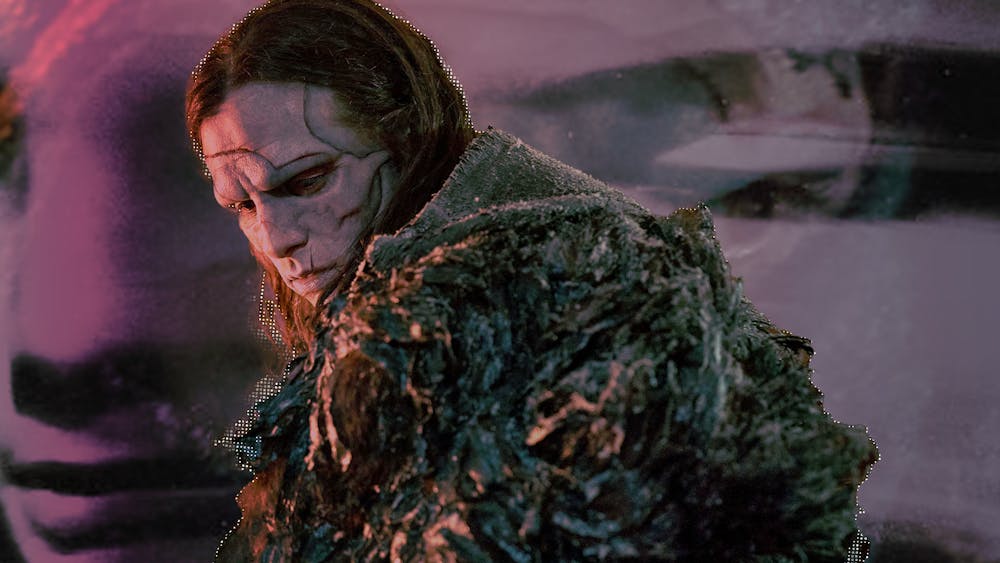
One of the film’s most quietly devastating scenes, and a shining example of Victor’s terminal stupidity, is the moment Victor catastrophically misunderstands the Creature’s plea for a companion. Shelley writes that the Creature longs for someone who shares his isolation, who can speak his language of exile. Del Toro sharpens that into something heartbreakingly simple: the Creature is lonely. That’s it. He wants someone to sit with him in the terror of being alive. But Victor’s ego metabolizes the request into something obscene, a reproductive threat, a biological impossibility, as if what the Creature asked for was a mate with a functioning womb and not, you know, basic emotional survival and connection. He cannot imagine desire that isn’t carnal because he cannot imagine a moral universe more expansive than his own. It’s the purest articulation of Victor’s failure—he cannot imagine his creation as a subject with desires that are not monstrous mostly because he cannot fathom the possibility that the Creature might simply be a better person than he is. The tragedy is that the Creature speaks with clarity, and Victor hears only projection. It’s the one moment where del Toro gets closest to Mary Shelley’s original wound: the loneliness of a child speaking to a parent who will never, ever understand him. It’s so on brand for Victor to turn a plea for affection into a scientific inconvenience. If the Creature had said he was hungry, Victor would’ve given him a lecture on agriculture. The man is allergic to the concept of empathy.
My one, singular gripe with Frankenstein is that the ending hinges on a quote from Lord Byron—the blueprint for men who think suffering makes them deep when it mostly just makes them immensely exhausting. This is the same Byron who had a teenage mistress, Countess Guiccioli and also fell in love with his own cousin. His journals read like case studies in self–inflicted chaos: his romantic relationship with his half–sister Augusta, his starvation diet of vinegar and biscuits, his compulsive need to mythologize himself as if narcissism were a vocation. Not even Mary Shelley’s Percy was safe. Byron emotionally tormented him, too, in an endless masculine performance of competitive suffering. It’s genuinely poetic that the biggest monster in Frankenstein’s wider literary ecosystem wasn’t stitched together in a lab—he was just born a man.
Victor wanted to be God but ended up being a bad dad, and those two roles are closer than he ever understood. The Creature—stitched together, abandoned, yearning—becomes the only thing in the story worthy of love. He’s the one who teaches himself language, who learns tenderness from eavesdropping on a family he helps in secret, who sits with a blind man and finally feels seen not through sight but through voice. The Creature is the only character who tries, sincerely and without ego, to understand what it means to care for another person. And that’s the tragedy Mary Shelley wrote into his bones: he becomes human in all the ways Victor refuses to. Victor chases divinity; the Creature practices compassion. One aspires to godhood and fails; the other stumbles into humanity and is punished for it.