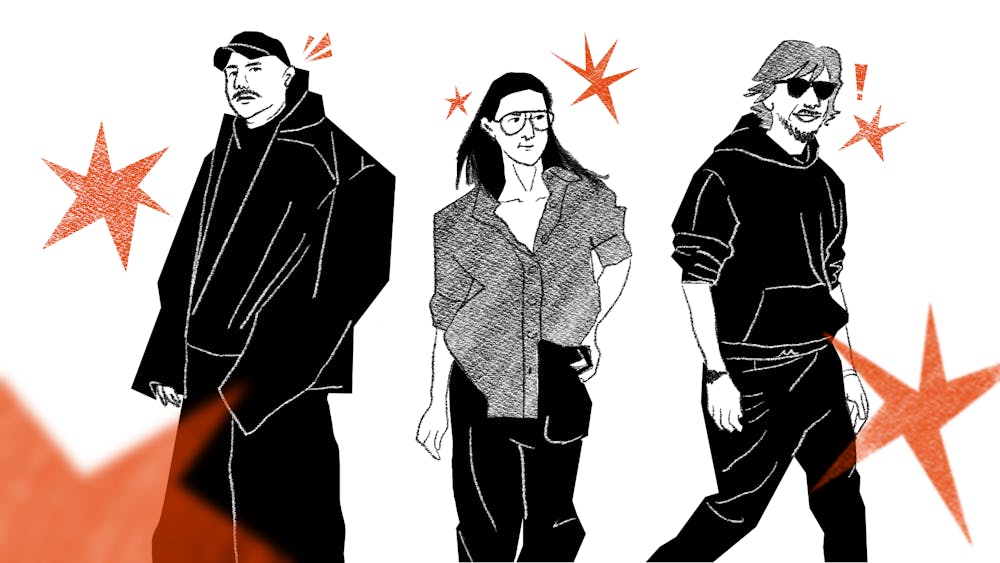
This season, we watched fashion’s most storied maisons get handed over like relay batons—Demna at Gucci, Jonathan Anderson at Dior, Blazy at Chanel, Jack and Lazaro at Loewe, PPP at Balenciaga, and a wave of lesser–known but just–as–high–stakes appointments. It was a game of musical chairs so dizzying it felt like the end of an era—and the start of a new one. But in a landscape increasingly driven by quarterly earnings, social media virality, and sheer aesthetic fatigue, the real question is: does anything actually matter anymore?
Fashion loves the myth of the genius auteur—Galliano’s Dior, McQueen’s Givenchy, Phoebe’s Celine—but the past decade has seen designers treated more like interchangeable assets than singular voices. Short contracts. Abrupt firings. Sudden departures blamed on “creative differences” or “burnout.” We’ve seen it all: Raf Simons’ blink–and–you’ll–miss–it Calvin Klein era. Clare Waight Keller’s romantic interlude at Givenchy. Daniel Lee bouncing from Bottega to Burberry. The system cares more about spectacle than creative longevity.
But some of fashion’s most iconic tenures started exactly like this: a sudden debut, skeptics circling, and then a show that changed everything. Think Marc Jacobs at Louis Vuitton in ‘97. Nicolas Ghesquière’s arrival at Balenciaga. Even Demna at Vetements.
Here’s our definitive ranking of the SS26 creative director debuts—from the generational reset at Gucci to the quiet chaos blooming at Versace.
Gucci by Demna – “La Famiglia”
It still feels surreal to type that.
When industry rumors emerged that Demna was leaving Balenciaga, most people scoffed. When the rumors said he was going to Gucci, the fashion world lost its mind. Gucci was the house of Italian sensuality, of Tom Ford’s hedonism and Alessandro Michele’s lace–and–liturgy romanticism. It’s a brand built on contradiction, sure, but earnest contradiction. Catholic guilt and 70s sleaze. Horsebit loafers and Dionysian orgies. The idea that Demna—the arch–pragmatist of post–Soviet dread, the king of irony, the designer who once showcased a fashion week collection entirely on The Simpsons—would become the creative steward of Gucci felt like a glitch in the fashion matrix.
There’s a certain type of fashion lover who has had to fight for their love of Demna. For every article that called him unserious, gimmicky, or worse, there’s someone who understood the structural brilliance underneath the memes. He’s the rare modern designer who is both a provocateur and a purist. People remember the Croc stilettos and the IKEA bag drama, but they forget he’s a trained tailor from the Royal Academy of Fine Arts in Antwerp, a man who can build a shoulder the way surgeons rebuild knees. La Famiglia is a character collection: every look in this collection is a character, a persona within Demna’s imagined Gucci dynasty complete with family portraits.
Alex Consani in La Bomba was easily the most talked–about look online. The silhouette is pure Demna: massive at the shoulders, vacuum–sealed at the waist, and hemmed into an unnatural, engineered curve. The entire look reads like a hybrid between Tom Ford’s bombshells and the structural grotesquerie of early–2010s Vetements: half–sex, half–threat. The bag is new–gen Gucci, but it’s also very clearly Demna’s baby. The Le Cagole echoes are deafening—chain strap, slouchy leather, too many zips, and just enough charm clutter to make it feel bratty on purpose. But instead of Y2K club rat, it’s been re–skinned in Gucci’s classic green–red webbing and softened with a Florentine accent.
Flora and La Contessa are Gucci canon. The Flora print was originally created in 1966 for Princess Grace of Monaco, so this is Demna dipping into house mythology. The structuring is insane. The sleeves on La Contessa feel like late–Victorian mutton chops warped into Demna’s signature hyper–architecture. The silhouette is more Northern Renaissance than Spanish—think Hans Holbein, not Velázquez. The use of black as a floral base for La Contessa gives it a slightly macabre elegance, like an oil painting that’s been hiding in a climate–controlled vault for too long.
In La Primadonna, Demna creates a kind of ironic homage to Gucci’s opulent excess, but drained of color, sex, and youth. The silhouette is unmistakably drawn from 1920s hostess robes: floor–length, voluminous, almost ecclesiastical in its drape. But instead of the usual jewel tones or Art Deco decadence, it’s rendered in a cold, neutral–toned, GG monogram jacquard—that iconic fabric, but now faded and past its golden days. It evokes the look of money, but not its pleasure. The ostrich feather trim is important here as a nod to the dying gasps of Old Hollywood glamour. Ostrich feathers were once the ultimate luxury trim, used on opera coats, boudoir robes, and couture eveningwear. On this look, though, they’re limp, exhausted. They frame the garment like cobwebs. It’s Gucci after the party, Gucci hungover in the morning light. And that’s where Demna’s tailoring genius creeps in: the piece looks loose and relaxed, but it’s engineered to keep the volume perfectly balanced. Where Tom Ford’s Gucci was polished provocation and Alessandro Michele’s Gucci was baroque fantasia, this is Gucci as artifact.
La V.I.C. (Very Important Client) is Gucci as a consumer phenomenon. The head–to–toe monogram ensemble—trench coat, stirrup trousers, matching tote, boots, scarf—recalls the full–look luxury of the 1990s, when logos became social armor. But Demna, famously a skeptic of easy consumerism, presents it with a kind of sterile reverence. This is branding without seduction. There’s no skin, no movement, no softness. It’s a rigid silhouette, carefully tailored for maximum impact: sharp lapels, exaggerated shoulder line, a belt pulled taut to suppress any natural shape. The trench construction itself is classic—double–breasted, mid–thigh—but the fabric, likely coated jacquard canvas, gives it a plastic–like quality. And that’s what makes this look so distinctly Demna: it’s critique masquerading as commercialism. He takes Gucci’s most profitable visual language, its logo, and overuses it to the point of invisibility. You stop seeing the woman—just see the market. It’s Balenciaga’s critique of fashion cycles, now executed using Gucci’s own tools. As a character in La Famiglia, she’s the daughter who never learned how to be a person outside the store.
Then there’s La Snob, the outlier that doesn’t attempt to mimic Gucci at all. It is straight from Demna’s Balenciaga vocabulary: all–black, body–con, aggressively sculptural. The fabric appears to be either velvet or neoprene, depending on the lighting—both favorites in his couture arsenal, both used for their ability to hold exaggerated forms. The exaggerated flared collar looks like a study in negative space—one part 1940s noir, one part sci–fi couture. It recalls his FW21 couture shapes, even sporting echoes of Cristóbal Balenciaga’s 1960s sculptural eveningwear. But there is zero Gucci precedent for this silhouette. No florals, no logos, no horsebit or red–green stripe. Just the Demna silhouette: severe, cerebral, and sculpted to intimidate. With his signature severity, Demna asks how much of Gucci’s future can exist without relying on its past.
Balenciaga by Pierpaolo Piccioli
To understand how deeply strange this pairing is, you have to go back to the essence of Balenciaga. Cristóbal Balenciaga, the house’s founder, was a purist. His couture in the 1950s and 60s was sculptural, monastic, and mathematically perfect. He stripped away ornamentation in favor of structure—collarless coats, cocoon backs, balloon hems, and volumes suspended from the shoulder rather than the waist. That logic was revived and retooled by Demna, who leaned into absurdism. Under Demna, Balenciaga became a philosophical exercise: fashion as critique, fashion as spectacle, fashion as menace.
Piccioli, on the other hand, has always been a believer in beauty. At Valentino, especially in his solo years post–Maria Grazia Chiuri, he expanded the vocabulary of romanticism. Colorblocking as sculpture, transparency as softness, embroidery as politics. His couture was deliberately, defiantly beautiful. Think acres of taffeta in high–saturation jewel tones, capes that flooded the runway, and silhouettes that seemed to float, not walk. But what grounded that fantasy was his technique—Piccioli understands the cut. His work is trained, meticulous, and unafraid of scale. That’s what first made him a candidate for creative director of Balenciaga, even if, on paper, he’s the antithesis of Demna’s entire ethos.
Backstage, Piccioli described his Balenciaga debut as a “manifesto about female emancipation,” which is a loaded phrase in the context of a house whose recent signatures were brutalist shoulder pads and genderless anoraks. But behind the press release politics, the real theme was more aesthetic than ideological: what happens when radical romance inherits a house of severity? It’s a rewriting of the house’s priorities, a shift from provocation to poise.
The off–the–shoulder jackets—oversized but fluid, cocoon–like—reference Cristóbal Balenciaga’s 1950s balloon coats, but they’ve been stripped of their historical weight. Instead of stiff gazar or duchess satin, Piccioli works in matte black leather, a nod to Demna’s toughened sensuality, but with Valentino–like finesse. Skirts echo Cristóbal’s famed balloon hems, but they’ve been reimagined in black silk faille or taffeta—materials chosen for their memory, their ability to trap air and return to shape. Piccioli cuts them full and high–waisted, grounding them with flat sandals or low–profile heels that avoid drama. Even the sheer gowns—gossamer tulle twisted across the chest—reject baroque excess in favor of choreographed softness. It’s not about spectacle. It’s about control.
Chanel by Matthieu Blazy
For the past few years, Chanel has felt like the luxury equivalent of a legacy media brand—technically present, historically important, but struggling to make anyone actually care. Despite blockbuster sales and the inertia of their iconography (pearls, camellias, tweed), the house has hovered on the brink of irrelevance in the eyes of younger audiences and fashion insiders alike. Under Virginie Viard, the collections rarely ventured beyond soft–focus heritage. Critics praised their “wearability,” but what they really meant was predictability. What was once an avant–garde house built on radical ideas—sportswear for women, trousers as rebellion, costume jewelry as subversion—had become conservative in the truest sense of the word.
Blazy’s debut introduced skirts that hit just below the knee—a subtle but loaded gesture, considering Chanel famously hated knees. Blazy’s lengthening of the silhouette created flares, folds, and wrapped around the body with weight and intention. It was a designer reasserting line and proportion as central to the house’s identity—not just trim and tweed. There was also a shift in material logic. Instead of fetishizing the classic boucle, Blazy used it sparingly, mixing it with stiffer wools, crisper cottons, and even coated silks that caught light like lacquer. Daywear carried the precision of couture, but none of the fustiness. The evening looks weren’t dripping in embellishment, but built from textile engineering—layered silk gazar pleats, hand–cut lamé fringes, and molded organza that curved like armor. Even the knitwear felt sculptural, not soft. The accessories—which Chanel relies on to fuel its retail machine—were similarly reimagined. The handbags remained recognizable, but their proportions shifted. Chain handles were thickened. Leather got tougher. The ballet flat was recut higher on the vamp, giving it a slightly martial edge.
Dior by Jonathan Anderson
Dior is drama. That’s how Jonathan Anderson described it backstage—and for once, the house actually lived up to that statement. For the better part of the past decade, Dior has been trapped in its own post–feminist limbo, straining to prove it was relevant without ever managing to be exciting. Maria Grazia Chiuri’s tenure flattened the brand into a slogan machine, more interested in faux–academic feminism and safe silhouettes than in doing what Dior used to do best: manipulate structure, seduce through technique, and say something dangerous through beauty. There was no sex, no subversion, no surprise—just endless reinterpretations of the tulle gown and the “We Should All Be Feminists” tee. It was beige, boring, and bad.
Anderson does surrealism and sensuality and subversion, and somehow, he made all three feel like they belonged at Dior. Dior has always been about contradiction: softness armored in structure, fragility framed by architecture. Christian Dior’s original Bar suit might have been famous for its wasp waist, but it was built like a fortress—boned, padded, layered, and sculpted from the inside out. Anderson’s debut opened with a total desecration of the New Look: the iconic Bar suit, but cropped into thigh–skimming minis that ended exactly where the original hem would’ve begun. It was brilliant. Anderson even turned Dior’s accessories—the Book Tote, the official bag of women who summer in the Hamptons and read one Zadie Smith novel a year—into something sly and literary. He replaced the logo with actual book covers: Ulysses, Dracula, In Cold Blood, Bonjour Tristesse. Yes, Françoise Sagan at Dior. This was the first time in years Dior felt like it was being made by someone with a vision, not just a checklist.
Bottega by Louise Trotter
For a house whose reputation recently rested on the cult of the “It bag”—Pouch, Jodie, Sardine, you know the drill—it would’ve been easy for Trotter to play it safe. Coast on accessories, pump out knit bodycons, do what people expect. But instead, she went for actual craftsmanship.
To most people, Intrecciato is just “the woven Bottega leather,” but that’s like saying croissant dough is just folded butter. Intrecciato is to Bottega what bouclé is to Chanel, what monogram canvas is to Louis Vuitton—but it’s rarer, quieter, harder to knock off. What Trotter did was go back to its origins: downsizing the weave strips to their original scale, turning the volume down to amplify the richness. The result was mesmerizing. Less gimmicky, more pure technique. The mackintosh done in mini–intrecciato leather was unreal, completely reimagining Bottega’s DNA when it comes to clothing.
Loewe by Jack McCollough and Lazaro Hernandez
Jack McCollough and Lazaro Hernandez spent two decades dressing the type of New York woman who has a dinner at Indochine, a deadline at The Cut, and a tote bag full of unread Joan Didion. Proenza Schouler was a city girl’s brand—clever, cool, wearable without ever being boring. So when the duo announced they were stepping down from the label they’d founded as Parsons kids to take over Loewe—Jonathan Anderson’s petri dish of surrealism and sensuality—everyone tilted their heads a bit. It was an unexpected marriage. Loewe, after all, is the most European of European houses: founded in 1846 as a leather collective in Madrid, now owned by LVMH, rebranded by JW Anderson into an art gallery/wardrobe fever dream. Its codes aren’t just about luxury—they’re about texture, wit, reconstruction, and the craft of seeing.
The new Loewe wasn’t trying to mimic the Anderson weirdness. There was no ceramic bust stuck to a dress, no trousers made from IKEA bags. What Jack and Lazaro brought instead was a kind of disciplined sensuality. Clean lines, slinky shapes, and—shocker—almost no trousers. This was a legs collection: asymmetrical skirts slashed up the thigh, leather micro shorts styled like afterthoughts, and bomber jackets that hung like you’d borrowed them from a boyfriend you were about to ghost. There was a current of physicality, but filtered through clever structure: sculpted shirting that folded in on itself, sweaters tied across bare chests, a minidress in patent royal blue paired with diving–shoe–inspired heels. Parisian snobs love to pretend Americans don’t “do” fashion beyond sportswear, but this collection had a quiet kind of defiance. Maybe this is what happens when two of America’s most disciplined designers are handed a European house known for indulgence: you get restraint with a wink.
Versace by Dario Vitale
Versace has never been subtle. That’s the whole point. It’s the house of sex, sheen, and cinematic excess—Gianni’s original vision was built on Medusa–head hedonism, high–saturation glamour, and bodies treated like sculpture. But somehow, every time someone tries to talk about the brand, they drag out that exhausted line: “Armani dresses the wife, Versace dresses the mistress.” It’s a false binary, deeply sexist, and completely misses what made Gianni Versace’s vision so powerful in the first place—not cheap provocation, but unapologetic sensuality as self–possession.
So Dario Vitale stepping in as creative director was always going to raise eyebrows. He comes from a more conceptual background, known for his work in costume and set design, and it shows. His debut was theatrical, sculptural, a little deranged, and very feeling–driven. The show was staged in a Milanese museum transformed into the ruins of a dinner party: half–eaten pastries, lipstick–smudged mirrors, Caravaggio shadows.
The collection itself leaned into that afterglow. Trousers unzipped and unbelted, dresses held together with a single button, bras that were more suggestions than garments. It was erotic, but not slick. That’s where it gets complicated, because Versace has always been about presence. Gianni’s designs screamed, “Look at me.” Donatella’s best years were built on the high–gloss mythos of the Versace woman: body armor with a slit. Even the sensuality was loud. It was about demanding attention, not reflecting on it after the fact. Dario’s Versace, on the other hand, is romantic, moody, and even a little sad. The casting, he said, was about bringing gods down to sleep with mortals, and the clothes reflected that—the models felt like mythic creatures caught in something fleeting, emotional, undone.
It’s beautiful in its own right. For those of us who grew up on old Versace—the drama, the diva, the audacity—it’s hard not to miss the punch. Dario is incredibly talented, and the show had vision. But is this kind of sensuality what Versace does best? Or is it just what fashion wants from it right now?
In an industry addicted to short–term narrative, each new creative director is expected to deliver a reinvention on arrival. Every debut is both a first act and a stress test. While this season offered moments of clarity, craft, and even brilliance, the question remains whether any of these designers will be given the space to build something lasting. For now, the carousel keeps spinning.