Earlier this year, The New Yorker pondered whether music criticism has lost its edge. Gone are the days of musicians throwing sandwiches at reporters who diss their lengthy songs. Have art and culture magazines become all bark and no bite for fear of repudiation?
Fear not. At Street, we may love to glaze the music we bump, the shows we just can’t get enough of, and the cultural moments that take over our feeds on X, the platform formerly known as Twitter. But to our very core, we are haters. What better way to end the year than to remember some of its very worst moments? After all, how can we celebrate the wins without commiserating the flops?
Maybe they don’t build statues of critics, but someone’s gotta do the dirty work. This one is for all our mean girls.
—Jules Lingenfelter, print managing editor
Daredevil: Born Again
I hold the opinion—which is shared by most who watch it—that Netflix’s Daredevil isn’t just one of the best superhero shows ever made, it’s some of the best television ever. Where Season 2 stumbles, Season 3 soars—every emotional and physical conflict is hit with precision. My favorite thing in any story is watching characters outthink each other, and Daredevil is built solely on that.
So, finishing Season 3 mere weeks before starting Disney+’s Daredevil: Born Again was a mistake. I went in wary; no reboot could match that original run, and every Disney+ show, aside from Loki, has disappointed me. Add in the behind–the–scenes chaos—fired writers, scrapped footage, total rewrites—and dread felt inevitable.
Turns out, the fear was justified. People praise the reshot Episodes 1, 8, and 9, but not even they can hide the lifelessness surrounding them. Matt Murdock (Charlie Cox) spends most of the season as a bystander in his own story, the supposed villain Muse (Hunter Doohan) looks great and does little, and the show crawls along like a terrible Law & Order Hell’s Kitchen edition. We, the audience, are wasting hours of runtime waiting for the story to unfold, and when it finally does, the season is over. Born Again doesn’t feel reborn—it feels embalmed.
—Henry Metz, Film & TV beat
Skims bush thong
The Skims nipple–piercing bra was one thing—for those of us who are afraid to commit to the needle for fear of passing out in pain or having our nipples fall off, it’s sort of nice to have an alternative available for when you want to temporarily spice up an outfit. Growing a bush, however? Painless. Free. No risk whatsoever of making your nipples fall off. I personally don’t care what you do with your hair down there, but unless you’re wearing a skirt the size of a belt a la Paris Hilton, the bush thong seems like an investment that’s both impractical and largely invisible in a day–to–day context. And yes, let’s bring back body hair. But let’s grow it and not buy it, please.
—Liana Seale, Film & TV editor
I Love LA
I Love LA spotlights all the unbearable parts of modern Los Angeles. I’ve heard Tallulah’s (Odessa A’zion) vocal–fried drawl echoing off the aisles of Erewhon, I’ve seen the rooftop content parties, the wellness influencers parroting the latest supplement trend at an event at The Grove.
The show’s characters are as vapid and obnoxious as the world they inhabit—an exaggerated, overfilled portrait that pokes fun at how artificial, self–promotional, and fake the city can look from the outside. And while I know there’s still plenty of authenticity here, the comedy lands precisely because these personalities do exist.
When I go home now, the city feels like it’s sprinting to keep pace with the TikTok algorithm. Din Tai Fung, once a beloved Taiwanese family staple, has become a glossy backdrop for influencer sponsorship dinners (and is featured in the show). Yes, it’s Hollywood. Yes, it’s satire—but it’s also horrifying, precisely because I’ve seen its beats play out in real life like a TikTok that somehow came to life and never stopped looping.
—Fiona Herzog, assignments editor
Taylor Swift and Travis Kelce’s Engagement Announcement
Against the backdrop of a lush, green garden dolloped with pink roses and white wildflowers, the Kansas City Chiefs’ tight end Travis Kelce sits on one knee. Taylor Swift, in her garden–party grey and white–striped sundress, holds his head between her hands. Yes, it seems the all–American “it couple” has officially gotten engaged. I guess the Chiefs didn’t need to win the Super Bowl to make that happen. “Your English teacher and your gym teacher are getting married,” Swift exclaims in the Instagram post caption, with a little stick of dynamite to seal the deal. Bold words from a woman whose lyrics rely on little subtlety and who relies on artificial intelligence to promote her music. It’s almost stolen valor for Swift to compare herself and Kelce—a billionaire and multimillionaire, respectively—to the hardworking educators that are infamously underpaid and overworked. Let us never forget, this is not a woman attempting to teach 16–year–olds Shakespeare amid the current administration’s campaign to dismantle the state of public education as we know it. Based on this latest string of out–of–touchness Swift has displayed, as one user of X, the platform formerly known as Twitter, put it, “I honestly think she developed secondhand CTE from close proximity to Travis Kelce.”
—Jules Lingenfelter, print managing editor
Slam Frank: A New Musical
Joel Sinensky’s very real musical Slam Frank: A New Musical first appeared on my feed about a year ago. Reminiscent of Lin–Manuel Miranda and Hamilton, Sinensky wrote a hip–hop musical—this time reimagining Anne Frank as if she were Afro–Latina. The show is meant to be so incredibly woke that it comes off as anti–woke, with Sinensky saying the common issue with all Anne Frank musicals is the constant white privilege of the main character.
Obviously, this is all satire—Anne Frank did not have white privilege as Jews were segregated into their own racial category and exterminated for it, and Sinensky is aware of this. While I understand his goal to make fun of hyperwoke culture, I can’t seem to feel okay with another Anne Frank joke.
Anne Frank was a young Jewish girl who was murdered at the hands of one of the most diabolical regimes to ever exist, simply for her Jewishness. I’ve never been one for Holocaust jokes, but my very much so not–Jewish ex–boyfriend once called me an antisemitic slur he made up. Sure, it’s a little funny, but only because I don’t wanna seem lame for not laughing along. Satire is open to all, and everyone has a right to their own sense of humor, but to me, Holocaust jokes, slavery jokes, and jokes about any other event so absolutely horrific that it permanently damages a community aren’t funny.
There are plenty of ways to make fun of the hyperwoke without turning a dead girl into a joke. Be more creative.
—Sadie Daniel, Focus beat
Sirens
Despite people joining cults at much lower rates than in previous decades, our fascination with affluent cultish activity has only increased. Media strikes gold when it teases out the question: What are these fucked–up rich people doing, and why can’t I look away? Sometimes, however, the premise outpaces the execution, as is the case in the recent Netflix series Sirens. It begins as a twisty, voyeuristic look into the lives of two estranged sisters. The eldest, whose role as her infirm father’s caretaker has led her to hard times and substance abuse, finds her younger sister working as the assistant and pseudosexual companion to an eccentric rich woman on an isolated property. There’s a lot of promising themes here of power, influence, and gender dynamics. But in the end—just like a real siren—this show lures you in with its entrancing song and ultimately leads you to bare rocks.
—Jackson Zuercher, foreign correspondent
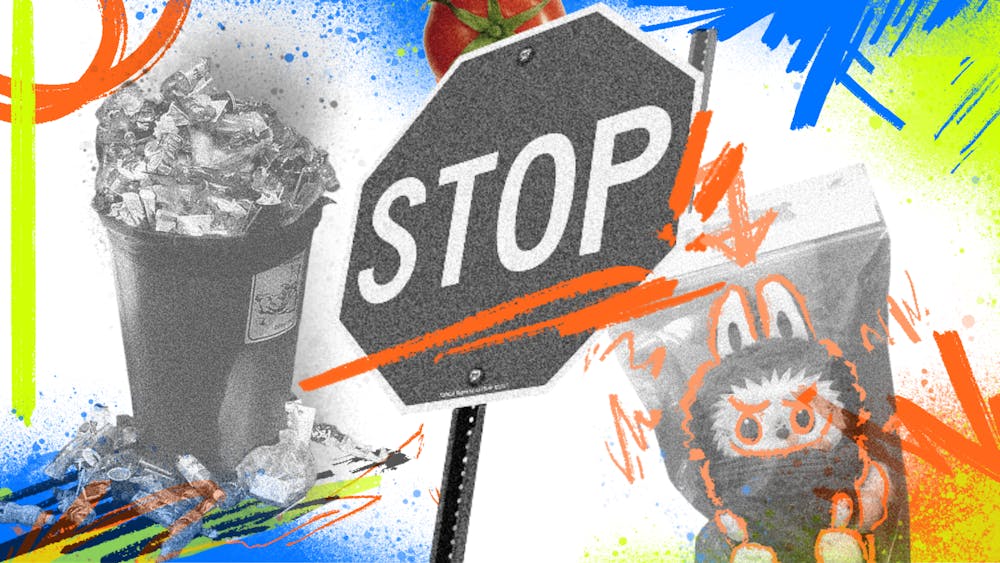
Labubus
“Liana, there just aren’t enough ways for me to showcase my love of overconsumption and lack of personality,” I hear you complain.
“Well, my friend, you could always get a Labubu,” I say to you, ever–concerned about your ability to fit in with the latest TikTok microtrends. Why do people waste money on these things? Is it for a small hit of whimsy in an otherwise drab day to day? Perhaps to feel a sense of ownership in a world that insists on subscriptions and rentals? Whatever it is, I’ve never understood the appeal, especially when these nonbiodegradable fuggos will sooner end up in a landfill than in your great–grandchild’s time capsule; admit it, as soon as your favorite influencer admits that they’re ugly, you’ll run to throw yours in the trash. And when that happens, you will pretend like you never liked them anyway, like you’ve been above it all this whole time, and you will look down on others who fell victim to the trend. But I’ll know that you’re not a real Labubu hater. Not like me.
—Liana Seale, Film & TV editor
Materialists
Your average rom–com is made up of two parts—the “rom” and the “com.” Materialists gives us neither. Harry (Pedro Pascal), Lucy (Dakota Johnson), and John (Chris Evans) all prove that money can’t buy you talent—their interactions are somehow both wooden and frenetic, ping–ponging wildly between banal small talk and wild confessionals. Neanderthals are involved, somehow. It helps drive home the film’s central question—should you value love or money more? Riveting, novel, brave. Above all else, I can’t remember the last time a movie made me this viscerally angry. Shitty commentary on the dating market? Lucy only leaving Harry after finding out he got leg–lengthening surgery? Dasha Nekrasova—need I say more? I walked out of the Film Society Bourse disenchanted, embarrassed that I had just spent two hours of my life watching whatever this was. I’ll never get married.
—Nishanth Bhargava, digital managing editor