
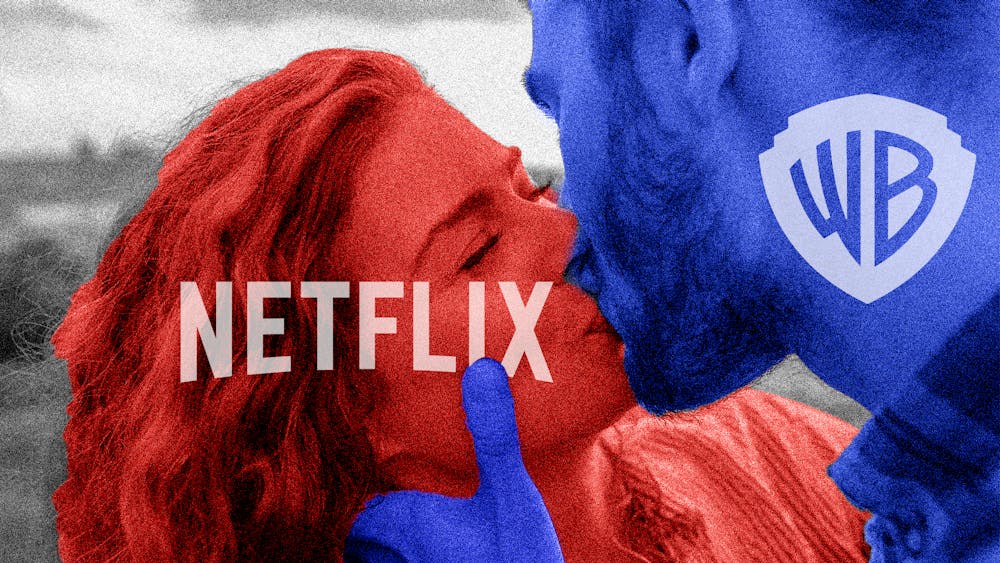
For almost a century, Warner Bros. has been one of Hollywood’s great institutions. It survived the end of the studio system, the rise of television, the streaming wars, and the era where every company tried to buy every other company. But somehow, the most dramatic chapter in its history is the one unfolding right now.
On December 5, Netflix and Warner Bros. Discovery announced a deal for Netflix to acquire Warner Bros.’ studios and streaming business—including HBO, HBO Max, DC Studios, Warner Bros. Games, and the core film and TV library—in a cash and stock transaction valued at about $82.7 billion in enterprise value and $72 billion in equity. After the deal closes, probably sometime in late 2026, Netflix will control everything from Harry Potter and Game of Thrones to Batman, Friends, and The Sopranos.
Shortly after this announcement, Paramount Skydance went hostile. On Dec. 8, they launched a $108.4 billion all–cash bid for the entire company—studios, streaming, and cable/TV networks alike.
In a letter to shareholders, Paramount’s CEO David Ellison argued the $30–per–share all–cash offer delivered is “financially superior” and a more “certain path to completion” than Netflix’s mix of cash, stock, and a spin–off stake, warning that the Netflix deal risked a “protracted multi–jurisdictional regulatory clearance process.” Paramount’s bid directly challenged not only the size, but also the fairness of the sale process—claiming that WBD’s board had favored Netflix from early on.
Netflix’s leadership responded calmly but pointedly. At a UBS investor conference on the same day, co–CEO Ted Sarandos said Paramount’s move was “entirely expected,” and that Netflix remains “super confident … we’re going to get it across the line of finish.” He insisted the Netflix–WBD deal is better for shareholders and consumers, and defended its potential to protect jobs in the industry.
Netflix’s rise gives the deal an almost surreal symmetry. This is the company whose founders were once brushed off by Blockbuster executives, whose offer to sell themselves for $50 million was waved away as a joke. Blockbuster collapsed, Netflix rewired the entire industry, and now the on–demand upstart that began by mailing DVDs is absorbing one of Hollywood’s oldest and most decorated studios. A business that once fought for legitimacy is now buying a century of film history—proof of how completely the balance of power has flipped.
When looking back on 2025, I noted that the only cloud over Warner Bros.’ dominant year was “corporate intrigue”—rumors that the company could become the industry’s most valuable acquisition target even as it topped the box office and HBO/Max owned prestige TV. That shadow turned out to be the whole story.
The fundamental question now isn’t whether this deal happens. It’s why something like it always felt inevitable.
How did Warner Bros. get here?
To understand why this sale exists at all, you have to rewind the corporate tape.
In 2018, AT&T bought Time Warner (rebranded WarnerMedia) in an $85 billion deal, betting that telecom plus content would create a vertically integrated powerhouse. The logic matched the moment: ‘content is king,’ data and distribution were the moat, and owning HBO, Warner Bros., and CNN seemed like the safest possible play.
It did not work. AT&T took on huge debt, struggled to manage both a phone company and a Hollywood studio, and watched as the streaming business demanded more cash, not less. By 2021, AT&T reversed course, spinning off WarnerMedia and merging it with Discovery to form Warner Bros. Discovery (WBD), which was valued at roughly $43 billion.
But that merger didn’t fix the problem—it magnified it. WBD started life with more than $40 billion in debt, a late start in streaming, and a portfolio of legacy cable networks that were slowly bleeding subscribers. The company entered survival mode. CNN+ was killed weeks after launch. Projects were pulled from HBO Max. Entire films, including Batgirl, were written off for tax purposes. The HBO Max brand was collapsed into “Max” in a bid to simplify the product and broaden its appeal.
The strategy was clear: cut costs, pay down debt, and hope that a tighter slate plus a stronger Max would buy enough time to compete with Netflix and Disney. The market never fully bought it. WBD’s stock traded far below its launch price. The debt load lingered. Streaming growth flattened. The company became an acquisition rumor you could set your watch by.
In June 2025, WBD made the rumors explicit, announcing plans to split itself in two: a “Streaming & Studios” company under the Warner Bros. banner, and a separate “Global Networks” company housing traditional channels like CNN, TNT Sports, Discovery, and various free–to–air outlets. The split was scheduled to occur in the third quarter of 2026. Even before the separation, WBD’s board admitted it was reviewing “strategic alternatives” after receiving unsolicited offers for both the whole company and individual assets.
Once that sentence appeared, the clock started ticking.
The looming threat of a sale
By the back half of 2025, the streaming wars had stopped being a land grab and started being a sorting process. Netflix had crossed 300 million global subscribers. Disney was wrestling with ESPN and Hulu. Paramount was mid–merger with Skydance. Peacock and Paramount+ were either acquisition targets or rounding errors, depending on who you asked.
WBD, meanwhile, sat in purgatory. Max and HBO together had around 130 million global subscribers—impressive in isolation, but dwarfed by Netflix and weighed down by the company’s debt. The studio division had a stellar creative year, led by a run of No. 1 films, but theatrical hits weren’t enough to erase the balance sheet.
The economics started pointing toward an inevitable conclusion:
- WBD was too big to be a niche player.
- It was too small and too indebted to comfortably go it alone.
- Its most valuable pieces—Warner Bros. and HBO—were logically worth more to someone else than to its current parent.
In other words, Warner Bros. needed either a giant partner or a clean exit. Once the board signaled openness to a sale, the idea that someone would buy the studio stopped being speculative and started feeling structurally inevitable.
The bidding war: Netflix, Paramount Skydance, Comcast … and everyone else
Once WBD opened the books, nearly every familiar acronym in media showed up.
Reports through October and November described interest from Netflix, Comcast (via NBCUniversal), and Paramount Skydance, joined by tech giants Amazon and Apple “kicking the tires” on either the full company or specific assets like the library. Preliminary bids were due in mid–November, with a second round following in early December.
Paramount Skydance, fresh off its own drawn–out fight to acquire Paramount Global, reportedly submitted multiple offers for WBD, including at least one in the mid–$20s per share that covered the entire company—cable networks included. Those bids were rebuffed as too low. As the process moved into exclusive negotiations, Paramount Skydance sent a blistering letter accusing WBD of running “a myopic process with a predetermined outcome” tilted in favor of Netflix and raising questions about management conflicts.
Comcast floated a structure that would merge NBCUniversal into WBD in a stock–heavy transaction. Apple reportedly explored buying only the Warner Bros. library. Amazon was linked as an interested party as well. None of those paths advanced.
Netflix, meanwhile, offered roughly $27.75 per share for the post–split Warner Bros. streaming and studios business—an $82.7 billion enterprise value that topped rival bids and, crucially, avoided taking on the cable networks. That offer, sweetened with a mix of cash and Netflix stock and backed by a $59 billion bridge loan from banks led by Wells Fargo, ultimately won.
The Paramount letter and complaining headlines will live on as footnotes. But in practical terms, the outcome isn’t complicated: the highest, cleanest bid—for the part of WBD everyone agreed was the crown jewel—came from the one company with both the balance sheet and the strategic needs to justify it.
What Netflix is actually buying
The deal structure matters because it answers a key question: what is Netflix getting, and what is it not?
- Warner Bros. Pictures and TV production
- HBO and HBO Max
- DC Studios and the broader DC Entertainment apparatus
- The Warner Bros. library (from Casablanca to Harry Potter to The Big Bang Theory)
- Warner Bros. Games and its subsidiaries
- CNN
- TNT Sports
- Discovery Channel, HGTV, Food Network, and other lifestyle brands
- European free–to–air channels and certain sports rights
Once the split completes in Q3 2026, those assets will live under Discovery Global, a separate company headed by current WBD CFO Gunnar Wiedenfels. Only after that spin–off will the Netflix transaction close.
In their joint announcement, Netflix and WBD went out of their way to emphasize continuity. Netflix said it plans to “maintain Warner Bros.’ current operations,” including theatrical releases, and to keep HBO Max as a discrete streaming service “for the near term,” even as HBO programming and parts of the library migrate onto Netflix. Warner Bros. CEO David Zaslav told employees that “HBO Max will stay,” at least at launch.
At the same time, Netflix told investors it expects $2–3 billion in annual cost savings by year three and agreed to pay a $5.8 billion breakup fee if regulators block the deal. Those numbers hint at what this really is: an efficiency play dressed as a creative one.
The antitrust question
Deals this big don’t glide through Washington or Brussels without drama. This one in particular arrives with drama baked in.
Even before a definitive agreement, Rep. Darrell Issa, a senior Republican on the House Judiciary Committee, sent a letter to the Justice Department warning that Netflix already “wields unequaled market power” with its more than 300 million global subscribers. He argued that a Warner Bros. acquisition would “diminish incentives” for new content and major theatrical releases. Sen. Elizabeth Warren later called the proposed combination an “anti–monopoly nightmare,” urging regulators to block it outright. Industry guilds and theater–chain associations have sounded alarms about what happens to theaters when the biggest streamer owns one of the biggest studios.
Regulators in the U.S. and Europe are expected to examine everything from streaming market share to theatrical windowing to labor conditions. Netflix executives have expressed confidence they will clear the hurdles, with co–CEO Ted Sarandos telling analysts the company is “running full speed toward regulatory approval.” But clearing a deal and clearing it without conditions are different outcomes.
The likeliest scenario, antitrust experts say, is not a full block but remediatory measures: commitments to theatrical releases, guarantees around licensing to third parties, or limits on how aggressively Netflix can bundle HBO Max into its own tiers. Whether those proposed conditions have teeth is another story.
What happens to HBO, DC, and beyond?
On paper, this is a neat fit. Netflix gets the one thing it’s never truly had—a century–deep library and a prestige pay–TV brand—while Warner Bros. finally gets the scale it couldn’t build on its own.
But each of the company’s big brands comes with open questions.
HBO / Max
HBO has spent decades as shorthand for ‘prestige TV.’ The risk in a Netflix world is dilution. The company has already said HBO Max will remain a standalone app “for the foreseeable future,” with a bundle option for users who subscribe to both HBO Max and Netflix, more akin to Disney+ and Hulu than a full merge on day one.
The long–term issue is curation and culture. HBO’s value isn’t only its library; it’s the fact that it programs like HBO, with curation and scarcity. Netflix’s value is the opposite—a firehose of global content sorted by algorithm, with volume and velocity. How those philosophies coexist inside one corporate structure will define what ‘HBO show’ even means five years from now.
DC Studios
DC finally found some stability under James Gunn and Peter Safran, with a soft reboot of the cinematic universe and a slate built around Superman and Supergirl. Under Netflix, DC becomes a direct strategic counterweight to Disney’s Marvel: a global superhero brand that can anchor everything from tentpole films to animated series to games.
The upside is obvious—Netflix’s distribution turns every DC show into a worldwide event by default. The downside is also obvious. Pressure to feed the platform could push DC into the same content treadmill that helped burn out Marvel—more projects, shorter gaps, and less patience for mid–budget experiments that don’t move subscriber numbers.
Franchises beyond: Harry Potter, Game of Thrones, Dune, horror, and games
This deal hands Netflix far more than superheroes. Harry Potter remains one of the most valuable IP ecosystems in the business, with a massive gaming arm (Hogwarts Legacy), theme–park relevance, and an upcoming Max series that Netflix now inherits. But Potter is only one axis. Game of Thrones continues to be HBO’s biggest global engine. Dune is an emerging franchise with real theatrical potential. Horror—from New Line Cinema to WB’s Conjuring universe—has been one of the studio’s most reliable box–office performers. And Warner Bros. Games gives Netflix a foothold in console–scale development for the first time.
Each of these categories raises a version of the same dilemma: does Netflix treat them as event storytelling or as subscriber infrastructure? The creative future of Warner Bros. depends on whether it can remain a studio, not a content supply chain.
The Netflix theatrical problem
In their joint statements, both Netflix and WBD emphasize that Warner Bros. movies will keep going to theaters. Existing distribution deals already commit the studio to a theatrical window through 2029, and Netflix has every incentive not to pick a fight with theaters while regulators are watching.
But the concern isn’t the next two years. It’s the established pattern of the past.
Netflix’s track record with theatrical releases has been cautious at best. It has experimented with wide releases for titles like KPop Demon Hunters and the Knives Out sequel Wake Up Dead Man, but most films still get limited runs designed to qualify for awards before quickly landing on the platform. The company’s entire business is built on training audiences to watch at home.
If you own Warner Bros., that tension intensifies. The studio’s identity has always been theatrical—giant franchise films, horror runs, mid–budget genre pieces that benefit from word–of–mouth in actual cinemas. Turning those into glorified marketing campaigns for Netflix subscriptions would save on prints and advertising. It would also accelerate the erosion of theatrical culture the studio has historically helped to sustain.
Sarandos insists Netflix has no “opposition to movies in theaters.” That’s reassuring, but intent is not a business model. The real test will come when a big–budget film underperforms at the box office but overperforms in streaming, and Netflix has to decide which metric matters more. Add to that the notion of theatrical windows evolving “to be much more consumer friendly” and “[meeting] the audience where they are quicker,” and one may start to doubt if this so–called “opposition” was ever more than a marketing line.
What this means for viewers
For viewers, the short–term experience might look like a win; more HBO and Warner Bros. titles on Netflix, a cheaper bundle than paying for multiple services separately (if there’s a bundle at all), and less hunting across platforms for one’s favorite shows and movies.
But underneath that convenience sits a different reality. A combined Netflix–Warner Bros. will control more than 420 million streaming subscriptions worldwide with a library that dwarfs every rival. When one company commands that much attention, the risk isn’t that there will be nothing to watch. It’s that the range of places where big, weird, ambitious projects can originate starts to narrow.
That’s the irony of this moment. In 2025, Warner Bros. won the year on both sides of the industry, dominating the box office while HBO/Max delivered the deepest TV slate on streaming. The Netflix deal turns that success into an exit.
What looked, from the outside, like a studio at the peak of its powers was really, from the balance sheet’s point of view, a studio preparing to gut itself to survive.
The studio that survived everything … and then sold
For a century, Warner Bros. has been the studio in the middle of every shift. It rode out the talkies, the blacklist, the blockbuster era, VHS, cable, and the first wave of streaming disruption. It outlived rival lots and outlasted trends. Even as ownership changed hands, the blue shield on the water tower remained a fixed point in Hollywood’s skyline.
This deal doesn’t erase that history, but it does rewrite what comes next.
If regulators approve it, Warner Bros. will no longer be an independent studio in any meaningful sense. It will be the engine inside Netflix’s machine—the brand that gives shape and prestige to a platform that’s lived most of its life without it.
Whether that’s a rescue, a surrender, or something in between depends on where you sit. For Netflix, it’s a way to lock up decades of stories and end the streaming wars on its own terms. For WBD shareholders, it’s a lucrative exit from a company trapped between debt and disruption. For theaters, creators, and audiences, it’s a precarious bet that one giant company can still care about the things that made Warner Bros. matter in the first place.
The studio that helped define movies and television now belongs to the service that changed how we watch both. Everything about that feels inevitable. None of it feels simple.