
Lace up your Nikes and get ready to ball.
Sony’s newest animated feature, GOAT, hit theaters Valentine’s Day weekend, earning close to $34M at the box office and emerging as a surprise contender against big titles like Warner Brothers’ Wuthering Heights. One could definitely attribute this success to the profitability of the family film genre—parents need to accompany children to theatres, so studio revenue doubles, on top of the release window taking advantage of children on break for Presidents’ Day.
Backed by NBA All–Star Stephen Curry and restlessly gracing the screens of NBA TV with promos, GOAT promises the viewer more than just courtside seats, throwing audiences into heated games of Space Jam–like basketball with Spider–Verse–level action. Yet compared to some of its predecessors, Sony Pictures Animation’s latest feature feels small, trading thoughtful character development and pacing for a plot that moves faster than the players on the court. In this way, GOAT never leaves viewers enough time to truly connect with the story, missing out on creating an emotional experience deep enough that it’s something parents and kids can enjoy equally.
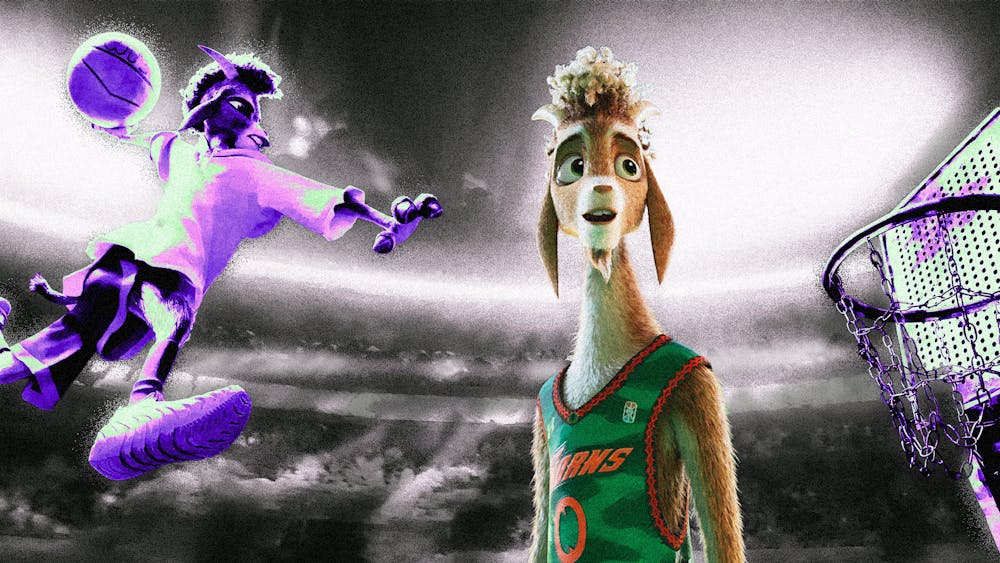
Set in an animal–dominated world similar to Zootopia, GOAT is the story of Will Harris (Caleb McLaughlin), a small goat with big hoop dreams. Will dreams of playing roarball: a colorful, dangerous version of basketball that takes place on (a)live courts with falling stalactites and flaming floors of magma. Inspired to play like his hometown hero—long–standing MVP Jett Fillmore (Gabrielle Union)—Will dreams of playing for his home team, the Vineland Thorns. After a video of Will taking on current champion Mane Attraction (Aaron Pierre) goes viral, he gets signed by the Thorns, and his dreams take off.
You can probably guess the rest. And the reason is because compared to Sony’s previous successes (KPop Demon Hunters, the Spider–Verse duology), GOAT relies more on formula while shying away from originality. Like Miles Morales, Will struggles to find acceptance and family in his new team. The Thorns feel like a rag–tag recycled version of the Spider–Verse ensemble cast: David Harbour voices a rhino drowning under the weight of babysitting his two reckless daughters; Nicola Coughlan is an ostrich with serious social media angst; Nick Kroll is a weirdly funny Komodo dragon; and Curry is a towering but laid–back giraffe hiding deep insecurities.
MVP Fillmore has one of the more complex character arcs, as she struggles with never having won a championship despite her all–star career. Her anxieties feel raw and close to what many athletes go through as they age out of the game. Her fear of being left behind by her team, the league, and her aging body feels genuine, and makes her selfish as she blames her team for bringing her down. And after expecting the team owner (Jenifer Lewis) to sign a stronger animal to the Thorns—because in this world, “small can’t ball”—you can imagine how she felt when her team signed a goat instead.
As a result, the story closely revolves around Will and Jett’s dynamic; as Will strives to learn from his hero, Jett pushes him away and even tries to put him down. What starts as a perfect example of “you should never meet your heroes” escalates into a mentor–mentee underdog story that leaves ample room for character growth, but unfolds too quickly to feel truly satisfactory. After repeatedly stealing the ball from her own teammates to win a match while pointing out their incompetence, Jett is forgiven too quickly by Will and the others. As a result, Jett’s gradual acceptance of passing the torch to Will feels predictable and doesn’t leave the deep emotional impact that it should.
One of the most heartwarming moments of the film comes when Will takes Jett to visit the old diner where his mom (Jennifer Hudson) used to work. There, Jett meets some of her most devoted fans—the ones who still believe in her. It’s a scene meant to celebrate the power of small–town fandom. But compared to the rest of the film’s pacing, even this moment feels a little too short–lived.
Where GOAT gets it right is its immersion of the viewer into the world of roarball. The action sequences are straight out of Spider–Verse; fast, comic book–esque, and instantaneous. One second, we’re following Jett weaving between towering polar bears to make a slam–dunk, and the next, the ice court splits down the middle, throwing the players into a continental drift as they struggle for footing. It’s a delightfully colorful sport, always evolving and upping the stakes. It’s no surprise that Sony brought Warriors All–Star Andre Iguodala and so many other NBA and WNBA players on board the project to ground roarball in authenticity. But even then, the actual pacing of the games feels quicker than it should, speeding through each quarter to get to the next beat in the story.
GOAT missed out on creating a shared experience that is equally enjoyable for both parents and their children, a gold standard in the industry, especially as the theatrical experience struggles for a comeback. As families further disconnect with their children due to social media and the lingering effects of the pandemic, family moviegoing could be key to restoring personal connection and building stronger bonds.
Could GOAT have been more GOATed? Absolutely. Backed by a monstrous global sports IP, led by an all–star cast, and made using award–winning animation styles, the film created ample opportunity to leave audiences moved and inspired, young and old alike. Instead, it shies away from developing its own potential, choosing the safety of guaranteed box office returns over playing the long game and creating a true cultural sensation.
Yes, Sony dreamt big. And they could have dreamt bigger.