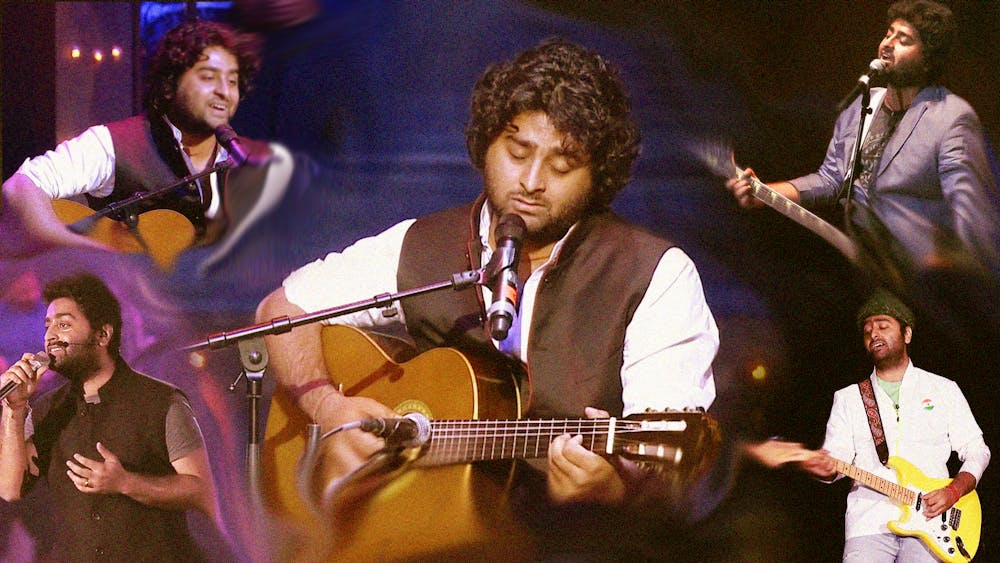
On January 27th, Arijit Singh announced on Instagram that he was “calling off” his journey as a playback vocalist to focus on his independent career. His retirement does not just signify the loss of one major player in the industry, but the start of a new era for Indian entertainment.
To appreciate the gravity of this decision, it is important to understand the significance of playback singing itself and Singh’s 15–year–long commitment to the art.
Playback singing is a practice in which vocalists prerecord vocals for a film’s song, which are then lip–synced by the actors. Film songs have always been one of the most popular musical styles in India, and playback singing has been a crucial and distinctive feature of Bollywood. From the legendary vocalists who pioneered it to the contemporary artists who have developed it, playback singers shape the sound of Indian cinema. In our current streaming era, film reception goes beyond the box office and relies on online consumption of the soundtrack. Individual tracks can often boost the film’s popularity, which explains why producers place so much importance on the playback vocalists they hire.
This is why Arijit Singh has had such a meaningful place in Indian culture and cinema over the past decade. In his 15–year career, he released over 700 songs as a playback singer. He has the most Spotify followers in the world, at 178 million, with 55 million current monthly listeners. His first major moment of recognition came from “Tum Hi Ho” on the Aashiqui soundtrack. He brought a raw, vulnerable performance to a genre that expected grandeur. It was a departure from the more polished, theatrical ballads expected at the time, which gave the song relevance and popularity that exceeded the film. It has been streamed over 500 million times on Spotify and still, over a decade later, remains an iconic piece of Bollywood music. His emotive vocal style soon made him highly in demand for the legendary ballads in classic Bollywood films like Channa Mereya and Kesariya. These songs have all resonated with audiences years later, largely because of Singh’s emotional style. Rather than only prioritising his technical vocal skills, he allows listeners to hear the unfiltered emotion that seeps through his performance.
What makes Singh’s decision so unusual and shocking is that he is currently at the height of his career and playing sold–out shows as a playback singer. While his announcement does not explicitly state a reason, he explained on his personal Twitter that he was getting “bored.” He has expressed similar sentiments over the years about hearing his music everywhere, constantly. On a personal and artistic level, this boredom is expected. When artists work on the same styles and musical forms for decades, they will inevitably experience stagnation. However, his boredom is also indicative of a larger issue that has plagued the Bollywood industry even before he retired.
In such a vast and versatile practice, Singh has become a gold standard—highly sought after for his contributions to soundtracks, which almost always yield viral songs. But this “standard” comes with consequences. Such heavy reliance on his talent has meant that film producers seek only his voice and sound. Filmmakers and composers would rather have Arijit Singh on their track, or someone who sounds like him, than a new voice. Over time, the goal became to sound like Singh to manufacture a popular soundtrack, which discouraged risk–taking in the industry. This not only took away space from other artists but also influenced newer vocalists to imitate him, stifling diversity to appeal to film producers.
Singh’s acknowledgment of the lack of variety in playback singing makes the issue harder to ignore. So, there may be a silver lining to his retirement—not only does he get to focus on his independent career and delve back into his Indian classical roots, but he will indirectly clear a path for a new wave of artists and vocalists to make a name for themselves.
Since he still has commitments over the next year to fulfill, it will be a while before we see a complete absence of his voice in new Bollywood. However, audiences are already starting to get a taste of what can happen when new vocalists are trusted with a soundtrack. Dhurandhar is a 2025 Indian thriller film and became the first Bollywood film soundtrack to have all its songs chart on Spotify’s Top 200. It notably incorporates a variety of styles, voices, and new names, all of whom have benefited greatly from the film’s success. Jasmine Sandlas and Madhubanti Bagchi provided their vocals on “Shararat,” an item song and one of the most popular tracks. While both have had previous moments of success—Sandlas, largely with Punjabi audiences—the film introduced them to mainstream Bollywood audiences. Viewers also saw the rising rapper Reble on tracks like “Naal Nachna” and “Run Down the City,” both of which have become her most popular tracks. The soundtrack's overall success and praise, particularly for its fresh sound, might suggest a general excitement among audiences for the diversity it offers in cinema.
Looking ahead, while Arijit Singh’s voice will be missed from films, we can only hope his retirement becomes a chance for a revitalised future for Bollywood. Audiences have been ready to hear new voices on their screens for some time now; it's now up to film producers and creators to give them what they want.