Apart from its breweries and record stores, Fishtown feels incidental on a Wednesday night—something to move through in passing. People drift along Frankford Avenue in clusters, stopping without committing to stopping—and by the time you walk through that shadowy arch into Johnny Brenda’s, it feel as though you’ve already entered mid-conversation; paused mid–sentence; stalled to listen.
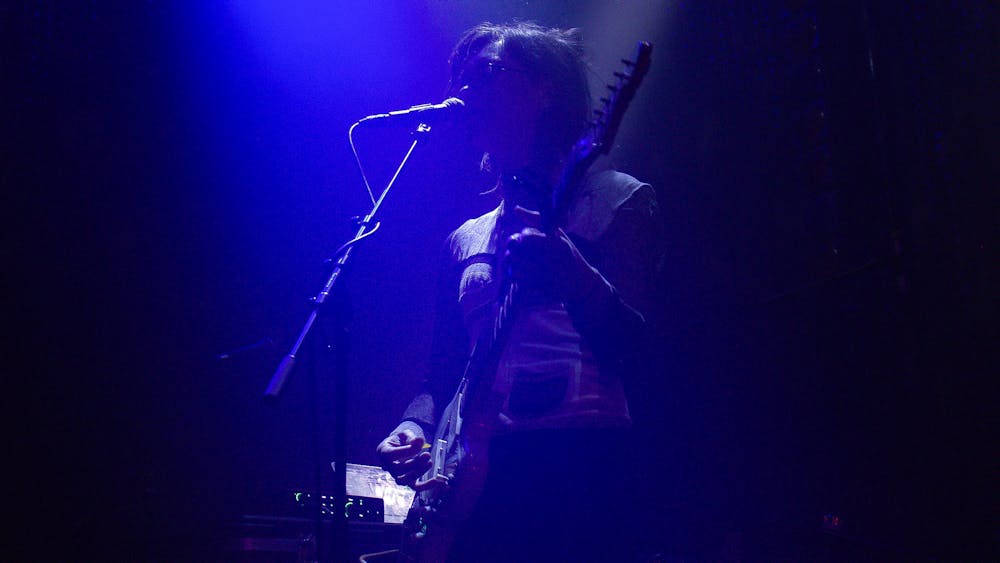
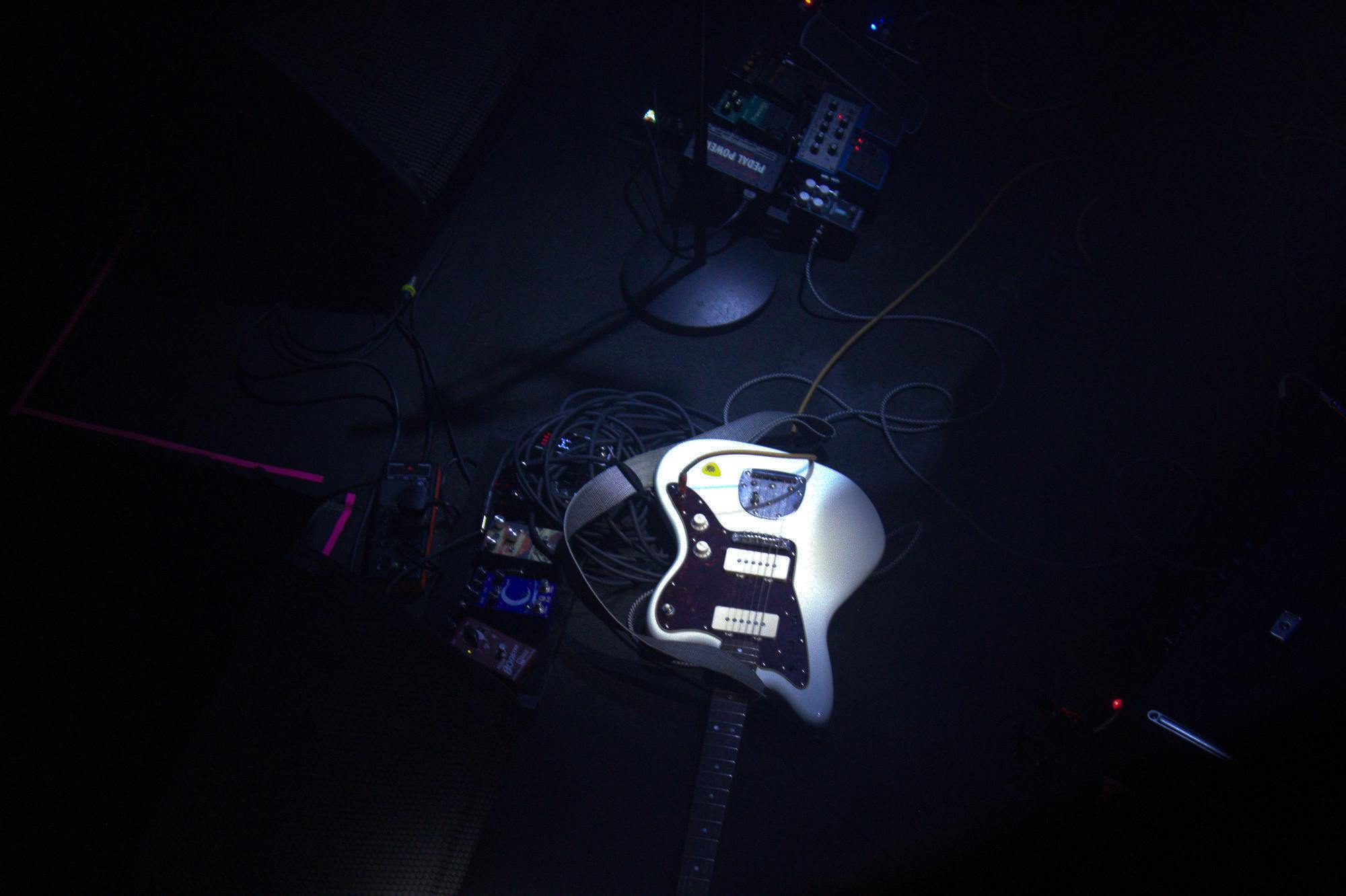
The room upstairs doesn’t present itself as immaculate. Its balcony presses low over a standing floor that gathers people into a loose, forward–facing shape, its corners holding small groups in conversation. The crowd is young but unassuming, lingering in pockets under cherubs and glowing beer signs. Every idle body orients itself, however casually, toward the empty stage, whose keyboards and cables and equipment sit in disarray—except for the microphone, which holds its place at the center with a quiet, almost stubborn inevitability. Its stiff persistence only echos as the lights soften—the already dim room collapses further into a thicker, more deliberate darkness. The microphone screams as a point of convergence, no longer inert, but waiting to be occupied. Gradually, her figure emerges within the low wash of color, steady and self–contained, replacing the vacancy.
Maria Somerville’s recent work mirrors this sense of enclosure. Atmosphere triumphs over structure, less a quality of the music and more an organizing principle. Luster, her 4AD Records debut, leans into that by building out a sound that feels both expansive and contained. The album is rooted in her return to Connemara, Ireland, and Somerville’s clear, sustained presence runs through all of the record’s 12 tracks. The category holds—dream pop, broadly—but the emphasis settles more firmly on fantasy. This compositional language is apparent in her sound world of gusting ambient electronics, loose guitar strums, and sparse percussion—a hazy departure from the heavier sound of her earlier EP, All My People.
Live, that vignette of sound only tightens in the space. It carries forward by a tidal wash of sound as she opens with a series of Luster tracks that gather slowly, almost imperceptibly, before folding into one another. The result is less a sequence of songs and more a sustained condition. The room softens—heads dip, bodies sway, the collective posture shifts toward the stage. Awash is the only word that quite describe it. We hum, or something close to it.
Somerville remains almost entirely still—hands at her sides, shoulders relaxed, dressed simply in dark trousers and a cotton vest. The lone microphone, reembodied, is resolved—it becomes a kind of conduit through which everything passes without lingering. There’s no gesture toward emphasis, no visible effort to direct the audience’s attention or translate the music into something physical. That work is already done.
Her performance introduces something closer to a pulse—a sense of forward motion. Some stragglers swing their heads in couples close to the stage. Clad in spiked hair and worn leather jackets, a scatter of bodies are turned upward without one clear expression—the only thing to watch, that can be watched, is the purple washing over the set, settling briefly on Somerville before dissolving again.
There’s a point in the set where the distinction between songs begins to blur; they refuse to separate cleanly from one another, each one carrying forth from fragment of the last—tone, texture, a lingering phrase, so that what emerges is continuous, bending but never breaking. It becomes difficult, then, to locate a single moment as definitive, to gauge attention, only that it has been held, continuously, without escalation.
Still, certain tracks from Luster assert themselves. “Projections” gathers slowly, its central motif surfacing with just enough clarity to orient the listener. A submerged, pulse–like beat emerges beneath Somerville‘s strained, searching vocal line. Perhaps the most rhythmically–tethered of the album, “Violet,” introduces a rougher edge. There‘s a faintly abrasive, almost scratch–like insistence running through its structure; the sound thickens and darkens slightly, and her vocals follow suit. They carry a cooler, more detached tone—just short of flat, deliberately withheld.
What becomes clear is Somerville‘s compositional instinct, privileging duration over contrast, allowing each song to function as a contained environment while still feeding into the larger field of the record. The strength of Luster lies in that balance. Perhaps more revealing, however, is Somerville’s recent Luster (Remixes) EP, whose reinterpretations test the original album’s elasticity. Collaborators like Seefeel stretch “Stonefly” into a slow–burning, almost tectonic drift, while YHWH Nailgun pull “Violet” towards an industrial, foregrounding rhythm that Somerville had allowed to recede. “October Moon,” with Boris, is pushed to a dense field of feedback that nearly overwhelms, but does not obscure, the source material. Even at their most transformative, the remixes never feel detached from the record; instead, they surface alternate, more extreme possibilities already latent within its sound.
Back in the venue, that possibility feels latent in the performance itself. As the concert comes to a close, the sound thins gradually; Somerville steps back almost imperceptibly; the microphones stands alone again. In response, the audience loosens—movement resumes in fragments and the space reassembles into a looser version of what it had been before. A step outside, and I see that the night has resumed its earlier rhythm, though it feels slightly sharper now. What remains is a sustained impression, lingering, before folding back into the drifting air over the sidewalk.