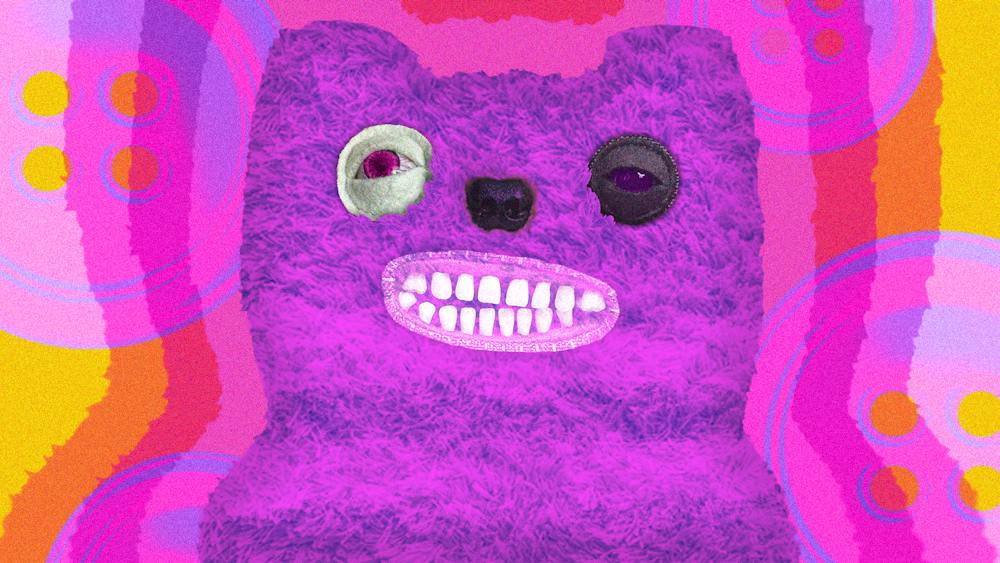
I collect Fugglers. I have spent countless dollars on these plushes with human–like teeth, vacant eyes, strange body proportions, and, in most cases, plastic “Butt–on holes” on their backs. For Fugglers, ugliness is not a flaw but the essence of the product. The official brand calls them “funny–ugly monsters,” and their current catalog organizes hundreds of variations around the same visual “offenses”: mismatched teeth, bloodshot eyes, lurid fabric, and vaguely threatening facial expressions.
I do not think my Fugglers are pretty; I am actually pretty certain that they are ugly. I just happen to think they are ugly correctly.
This distinction becomes stranger when I look at the origins of the Fugglers. Around 2010, United Kingdom toy designer Louise McGettrick stumbled upon a bag of fake teeth on eBay and immediately imagined an elderly woman sewing them onto a homemade teddy bear. She eventually bought the teeth herself and began making Fugglers, despite having almost no experience making plush toys. The early Fugglers looked crude, partly because McGettrick was still learning how to sew with a flimsy sewing machine.
When McGettrick first listed Fugglers on Etsy, she thought people would find the very existence of such toys funny. She never expected anyone to actually buy them. But they sold. The first buyers seem to have been those already comfortable with Etsy’s handmade novelty market, and McGettrick says a community formed around both love for them and reactions of disgust. Afterward, based on online feedback, she continued to refine the mouth shape, eyelids, fabric, and arrangement of the teeth.
The early Fugglers were not designed to look awkward; the production process itself was awkward. In contrast, today’s Fugglers have to intentionally and consistently reproduce the marks of inexperienced making in batches of thousands. A licensing agent discovered the Fugglers online and immediately saw their mass–market potential, and Spin Master acquired the brand rights in 2018. Addo Play subsequently became the official licensee, and now ZURU sells an extensive collection of products, including those featuring The Powerpuff Girls and Care Bears, as well as the Fugg Stars line, which turns celebrity personas like Justin Bieber, Elvis Presley, and Billie Eilish into plush caricatures. What began in fun has now become a full–fledged intellectual property capable of absorbing other famous IPs. This raises a rather peculiar industrial problem: how do you mass–produce something whose appeal depends on looking ugly?
A single Fuggler seems to manifest imperfection. Put enough Fugglers together and you realize their supposed mistakes are systemized, with repeated body templates, crooked teeth falling into nearly identical alignments. With the same Fuggler scaled into keyring–sized, standard, and oversized versions, the brand has transformed ugliness into a recognizable design language.
However, the design has never really strayed from cuteness. Sianne Ngai writes about cuteness as an aesthetic associated with smallness, softness, vulnerability, manipulability, and commodity culture. On the surface, Fugglers seem to subvert that formula, but upon a closer look, they are subversively adhering to it. The bodies are still small, soft, and round—just right to place on a bed or a bag.
Their faces cause most of the disturbance. The misshapen teeth, in particular, stand out. The mouth suddenly inserts an overly specific part of the human body, and that slight mismatch makes the entire toy seem unsettling. However, I do think any sense of discomfort is thoroughly controlled. There are almost no elements—such as wounds, decay, or mucus—that would make one reluctant to touch it. So, Fugglers may wear distorted expressions, but they still retain the softness and possessability of a stuffed animal.
Such limits become even more apparent in character collaborations. The Powerpuff Girls already embody the language of exaggerated cuteness with their giant eyes, round heads, and tiny bodies. Their Fuggler versions can be given human–like teeth and silly faces, but the distortion can only go so far before Blossom, Bubbles, and Buttercup stop appearing as themselves. This reveals that there is a line that must be maintained when it comes to commercial “ugliness.” It must be strange enough, but not so strange as to be unrecognizable. It must be jarring enough, but not so unpleasant that I would not want to touch it. Ugliness may seem like a kind of aesthetic free–for–all, but in reality, it operates within a very narrow range.
Collectors, too, participate in this same calibration. I do not want every single Fuggler. Some are too ordinary to hold my attention, and others are uncanny in a way that simply does not work for me. The portmanteau name itself celebrates unconventionally attractive plush toys, but I think it is closer to creating a new set of standards—we are constantly judging what is too normal, what is excessive, and what is “just right” in its strangeness.
So, it is insufficient to interpret the popularity of Fugglers simply as evidence that people are now rejecting aesthetic standards. What Fugglers show is that ugliness can become a category of taste in its own right, with forms that are repeated, branded, licensed, and judged against one another. In the end, Fugglers do not really ask us to stop caring about appearance. They ask us to become more precise about which kinds of unattractiveness we prefer. We still sort, compare, reject, and choose. The company is counting on exactly that.