Hometown: Washington, D.C.
Field of Study: English Major with Creative Writing Concentration, Consumer Psychology Minor
Activities: Chair and cast of Mask and Wig, editor–in–chief of the Woodlands Magazine, instructor of Cosmic Writers, playwright of TAC–e winter one–acts festival, member of TEDxPENN speaker and content team
“Poetry will come to me while I’m in downward dog,” admits Sophia Hall (C’27) as we discuss the remarkably unique and whimsical worlds in her writing. For Sophia, poetry follows her everywhere: tucked into a childhood memory, spontaneously scribbled into her notes app, and hidden in the quiet moments between yoga poses. Her writing transforms these fragments of everyday life into something tangible, using her nationwide recognition to reach her creative community. Despite having won more awards than most people have words on their resume, Sophia carries her achievements with a certain humility that is rare to come across. From writing cherry blossom haikus in second grade to being awarded DC Youth Poet Laureate in 2023, Sophia has navigated the ever–shifting terrains of poetry by embracing the unconventional, having found her own creative community at Penn and beyond.
Let’s start from the beginning. How did you get into writing?
Growing up, I was one of those kids who read everything. I would read the back of shampoo bottles, the bottom of cereal boxes, literally anything that had words on it. It got so bad that I would read my book on the handlebars of my scooter. In second grade, one of my assignments was to write a haiku about cherry blossoms in D.C.; this was my first exposure to poetry, learning how to use language in a poetic way, and capturing the beauty of these trees with words. When the pandemic happened, writing and journaling were the only way that I was able to capture all of these teenage–angst feelings of nostalgia down into words, and I think it was really formative for my writing as I was finally able to slow down and write a lot for the first time.
What would your words of wisdom be to someone who is having writer’s block? How do you tend to cope with it?
I think writer’s block really sucks. When you haven’t written for a while, it sometimes feels impossible to lift the pen again, and it’s really intimidating to stare at a blank page. What I normally do is word dump, but I would also advise people that every human experience you’re in is actually cultivating your own writing journey: from overhearing a conversation next to you, to going ice skating with your friends. Investing in the time you have is much more nourishing for your writing than simply staring at a blank page in anguish. Sometimes I do yoga—I love yoga. Poetry will come to me while I’m in downward dog. My notes app is also probably my poetry graveyard. This poet, Ada Limón, once said something around the lines of: keep one journal because you only have one life. So, if you are writing anything, just put it all in the same journal. And of course, a to–do list can live next to seeds of poems, and a song lyric you can’t get out of your head can be right next to pages of long division.
What is your favorite thing to write about?
Much to the chagrin of my family, I usually write about them. My mom, my brother, and my experience of growing up are some of the themes that I keep coming back to. Especially as I just celebrated my 21st birthday. I’ve been reflecting a lot on how I’ve changed throughout the course of my poetry, tracking the evolution of my thoughts and attitudes. I’m a first–generation Ukrainian American, so a lot of my time at home was spent speaking two different languages, eating delicious home–cooked meals that my grandma would make, and singing Ukrainian nursery rhymes. There’s this one quote that goes, “everything you’ve experienced up until the age of ten is all that you’ll ever write about again.” And I think there is a certain truth to that. You will always have those core emotions that you’ll keep investigating and probing, but because of your years of experience later, you can analyze it or use it in different ways.
From being selected as DC Poet Laureate to winning the Apple TV Plus National Portfolio Award for writing, can you tell me a little bit about your experience winning all these awards? Dwo you have a favorite one?
I think winning all of these awards truly is a double–edged sword, especially if you’re highly competitive. I consider myself a Type A person because I put a lot of pressure on myself. Every single time I write a poem, I have this hypercritical lens of like, “Oh, is this good enough to win XYZ? Is this polished enough to go into this magazine?” And I’m holding myself to this impossible standard. And truly, I am so grateful to be so widely recognized, because with this recognition my poetry becomes more accessible to a wider community. It also means that poetry in general is getting elevated and becoming legitimized as an art form and genre. Winning DC Youth Poet Laureate meant that I had a title I could use when advocating for change in my community, like putting up poetry installations in Washington, or hosting different open mics and spoken word events at cultural institutions like the Kennedy Center (rest in peace) and the Cherry Blossom Festival in D.C.
I think one of my achievements that I’m most proud of was in my freshman year of college, when I was selected to perform in an advertisement for Giant Food, a regional supermarket chain. They were doing a specific campaign where they wanted to highlight different spoken word artists from the D.C., Maryland, and Virginia region. I really got treated like a movie star: I had a hair and makeup trailer, I memorized lines that were part of a poem, and then it aired on TV. People would send me videos saying, “Oh my gosh, I saw you in an ad!,” and it was even played during the NFL football semifinals. It was really cool.
What has your experience been like finding your own community in the arts and writing at Penn?
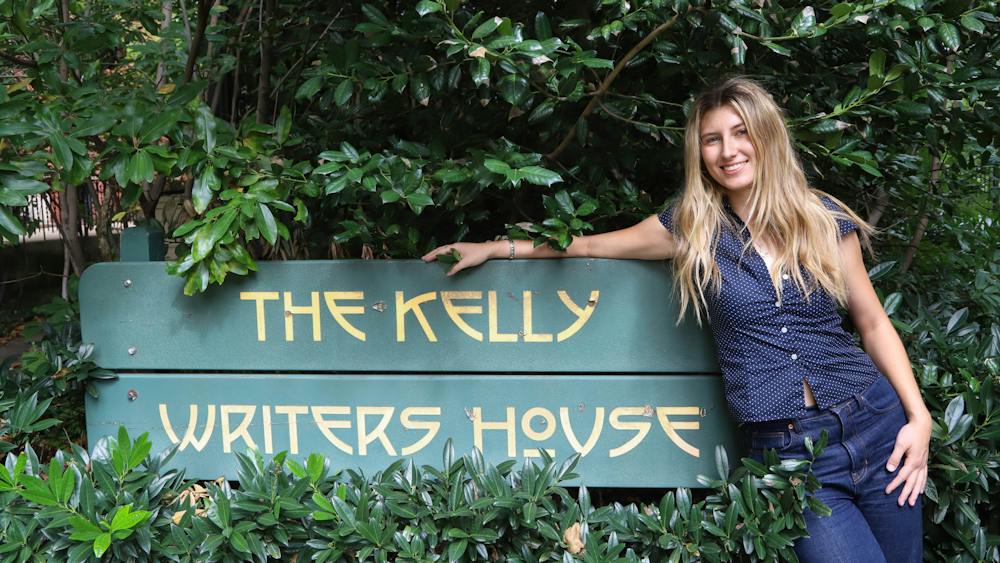
I think that, like anything at Penn, you do have to do a little bit more investigation if you want to find your own creative community. Sometimes it just involves stepping off of Locust and into the beautiful Gothic cottage that is the Kelly Writers House. You just have to go through some trees and look past the leaves to enter. Even though there is a lot of pre–professionalism at Penn, I think that to be a full–time writer, you do need to have some entrepreneurial qualities. Being a poet is basically like being a freelancer: you need to know the business of writing, how to market yourself, and how to market your poetry. All that being said, there are so many communities at Penn where I still get to be creative. One of them is the Woodlands Magazine, which I’m currently the editor–in–chief of. We’re a long–form creative nonfiction publication that really embraces creativity and leans into the in–between. I’m also the chair of Mask and Wig, which is a musical theater comedy group on campus. Every year we perform two original, entirely student–written shows: one on campus and one in our historic clubhouse in downtown Philadelphia. So I think through that, I’ve found creative outlets where I can write, perform, sing, dance, and read poetry with friends.
What is your opinion on the more unconventional forms of writing, and have you ever stepped outside your comfort zone?
Experimental poetry really challenges me, but I think that the form follows the function of the piece. If there is a poem that doesn’t make any sense and it’s utterly incomprehensible, like the modernists were trying to do with Ulysses and T.S. Eliot’s “The Waste Land”, it’s pointing to the fact that what they’re writing about doesn’t make any sense. Sometimes we all need to question why we’re trying to make sense of nonsensical experiences. I think it’s really fun to experiment with different forms, and I’ve definitely tried a few in the past. I’m actually working on one of them for my creative writing honors thesis: a nesting doll poem. So a nesting doll is a hollow wooden doll that you open up in half, and then there’s another one inside of it, and another one inside of that, etc. I wanted to explore what a nesting doll poem would look like: would it have a rhyme scheme that inverts halfway through the poem? Would it be a big chunk of text that slowly gets smaller and smaller until it condenses into the solid, smallest form in the middle? Sometimes you just have to sit with the uncomfortability of the unconventional.
And finally, what’s your poetry–related hot take?
My hot take is that there are two different types of English majors: the Fisher–Bennett English major and the Kelly Writers House English major, and never shall the two meet. The Fisher–Bennett English major is characterized by a more dark–academia aesthetic, spending a lot of time in the library analyzing texts. The Kelly Writers House, on the other hand, is more creative and a little bit more whimsical, if I do say so myself. In their free time, they hang out on the green couch with their friends, or write typewriter poetry.
LIGHTNING ROUND
What’s the soundtrack of your life right now?
The Pride and Prejudice movie soundtrack.
What book changed your life?
Demon Copperhead by Barbara Kingsolver. The ending will get you every single time.
What type of dog breed would you be?
Definitely a sheepdog (I have way too much energy and zero chill).
What is your go–to froyo order at Kiwi?
Tart base topped off with some kiwi. Duh.
Fill in the blank: there are two types of people at Penn: People who go to Mask and Wig shows, and people who don’t.
And you are? Someone who is in a Mask and Wig show.
Did you ever have a really inspirational teacher?
Miss Redman. She was my second grade teacher, the one who assigned the haiku in the first place, and probably one of the first people who cultivated me. For my Penn admissions essay, I addressed the letter to her because, without her haiku assignment, without writing about those cherry blossoms, I probably wouldn’t have had that first initial spark. And all throughout high school, I had some crazy English teachers. But you know, I would lay down my life for every single one of those English teachers. They really cared about what they were teaching, the books we were reading, and making sure that we felt understood.