
Whether you’re a film critic or a casual moviegoer, chances are you’ll have a strong opinion about the true purpose of cinema. Some directors make films to be pure blockbusters—forms of mass entertainment with simple, easily digestible themes. Meanwhile, others create films to inspire conversation about deep–seated societal issues, and believe there is more to film than simply entertaining an audience. But whether intentionally or not, most films take a stance—whether it be advocating for a relevant societal issue, or making simple commentary on timeless values such as good versus evil. Because of this, some scholars go so far as to argue that the essence of film, by its very nature, is political.
Writer and director Cristian Mungiu, however, leads with a slightly different approach. Winner of this year’s Palme d’Or—the most prestigious award at the Cannes Film Festival—for his recent legal drama Fjord, Mungiu makes a case for approaching complex, divisive issues with openness and ambiguity.
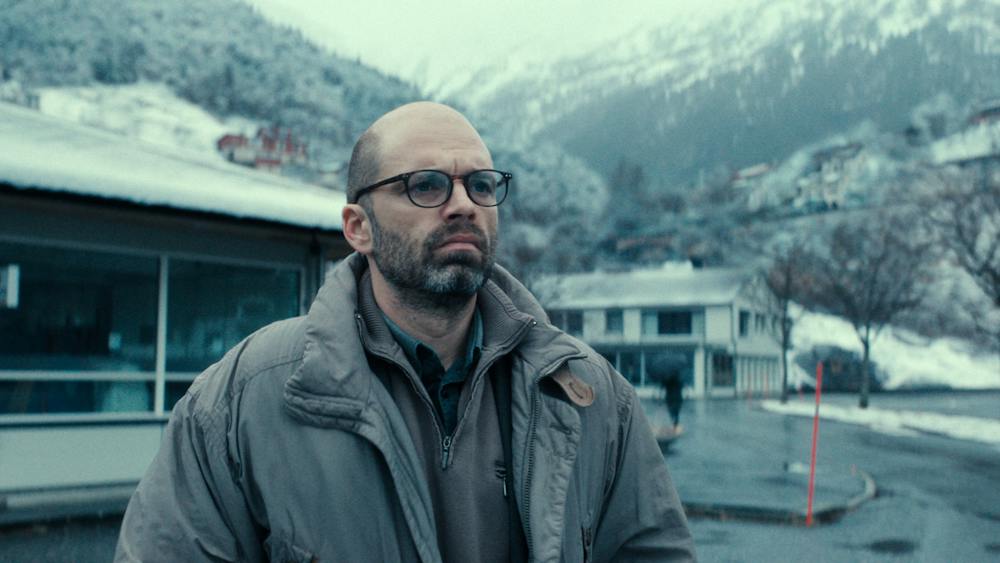
Released just last week, Fjord follows the Gheorghiu family immigrating to Norway from Romania. After the townspeople who run the local public school discover bruises on their eldest child’s body, the Gheorghiu’s lives get turned upside down when they are pulled into a legal battle against the state–sponsored Child Protective Services over custody of their children.
I had the opportunity to attend a Director’s Roundtable with several other college journalists and hear firsthand from Mungiu about the artistic thought, care, and talent that went into the making of this year’s Palme d’Or winner.
When it comes to tackling deeply divisive issues, Mungiu approaches his subject matter with both nuance and the belief that there is no singular truth. In his 2022 feature R.M.N., he depicts a conservative society that shows little tolerance for those it labels as foreigners, specifically those not aligned with the values of the majority.
When writing Fjord, however, he wanted to “reverse the paradigm,” curious to explore what would happen if a conservative minority were to live in a progressive, liberal majority. “You’d normally expect that the majority, which is liberal and progressive, would treat them differently because the values are different,” he says. But Child Protective Services doesn’t; they use legal force instead. What he realizes is that despite the progressive majority, “[they] tend to impose [their] values [on] the others instead of [applying their own] values about empathy and about inclusion.”
Mungiu based Fjord on a 2015 legal case following Ruth and Marius Bodnariu, who immigrated to Norway from Romania and had their children forcibly removed by CPS after they admitted to ‘spanking’ them. “I start from these pre–existing stories because I see in them the potential of speaking about something bigger than meets the eye,” Mungiu says when asked about the journalistic inspiration behind his work. His emphasis on objectivity—on presenting audiences with facts from real–life events—comes from his belief that we live in a “radicalized society in which we’re just talking to people from our bubble that share our views ... we try to not want to see that so many people [have] different views.” Fjord’s main characters—the Romanian patriarch Mihai (Sebastian Stan) and his Norwegian wife Lisbet (Renate Reinsve)—are deliberately complicated. Although Mihai admitted to giving his children ‘a slap on the butt’ if they didn’t behave and Lisbet agreed to forcibly shoving her children away from a boiling pot to protect them from getting scalded, the audience never sees the domestic violence. The deliberate choice to omit any hard evidence of violence is, once again, inspired by Mungiu’s research. After speaking with several parties involved with the 2015 case—including the family and the children themselves—Mungiu still could not figure out a clear–cut truth. “I couldn’t tell what happened in the family. I couldn’t tell [...] what was the degree, for example, of violence within this family.” This added even more ambiguity to the film’s messaging, focusing less on denouncing one set of values and more on highlighting the need for dialogue between disagreeing factions.
From a production standpoint, Mungiu spoke to how circumstances forced him to make different creative choices that only reinforced the film’s themes and emotional tension. During the first day of filming, they were hit by a storm causing Mungiu and his team to shift their entire shooting schedule. The only scene they could feasibly complete with the actors available was the most difficult of the entire film: the confrontation between Lisbet and CPS after they come to her house to take her children. Mungiu suddenly recognized that the weather could parallel the internal turbulence and conflict within Lisbet’s character during this scene, and devised a way to show this visually. In the nearly ten–minute long single take, Lisbet’s frustration is symbolically complemented by a Norwegian flag blowing aggressively in the wind. The flag—visible behind her through a window—was added to demonstrate the turbulent weather outside. “All of a sudden, [...] you are feeling what she was feeling, this kind of frustration also through this visual language of this flag. I thought that this is part of the film and I let it be included.”
For my question, I pointed to one of the more subtle but powerful relationships in the film: the unexpected bond between the eldest Gheorghiu daughter Elia (Vanessa Ceban) and her neighbor Noora (Henrikke Lund–Olsen).
Although the adults of the film are the central point of view, Elia and Noora’s friendship becomes an important symbol of openness and understanding. Noora doesn’t look down on the Gheorghiu family’s devout religious practices; instead, she seems intrigued by them. She introduces Elia to things that she is otherwise forbidden from doing at home. She even plans to run away with Elia if CPS doesn’t return her to her family. After the Gheorghius regain their children and flee the country, Noora begs her mother to drive them to the ferry before they leave. The film ends with Noora standing on the port, yelling “I love you” to Elia as she waves goodbye. “I think that they are the characters in the film that show a lot more openness towards the values of the other,” says Mungiu, in regards to what Elia and Noora’s relationship represents to the film’s central conflict. Through the love and understanding between these two girls, audiences understand that “there isn’t just one single, simple truth.”
Despite its success at Cannes, Fjord is currently receiving mixed reviews, with some critics branding it as an obviously “right–wing” film, while others write that Mungiu’s attempts at neutrality fall flat. Yet Mungiu still maintains that his goal is, ultimately, not to champion one ideology over another, but to let the audiences confront their own personal views. “I think some problems people are having with the film comes also from watching a lot of mainstream cinema in which everything is clear.” For him, the aim of Fjord is to expose spectators to a set of values absent in their world because, according to him, audiences tend to consume cinema that already fits into their worldview. His characters don’t represent a singular “truth” for the audiences to take away, nor do they reflect his own personal beliefs as the filmmaker. Instead, Mungiu’s characters are simply “quoting what these people believe and not claiming in any way that this is the truth.”
Fjord ultimately invites audiences to use the same “critical spirit” that they would otherwise be asked to use in real life to understand and rationalize the events of the film. Through this process, Mungiu believes the audience is able to think through the conflicts and events depicted by the story, and apply this thinking to the issues that permeate their own lives.
Even in generating these polarized reviews, Fjord achieves its exact goal: sparking dialogue.