
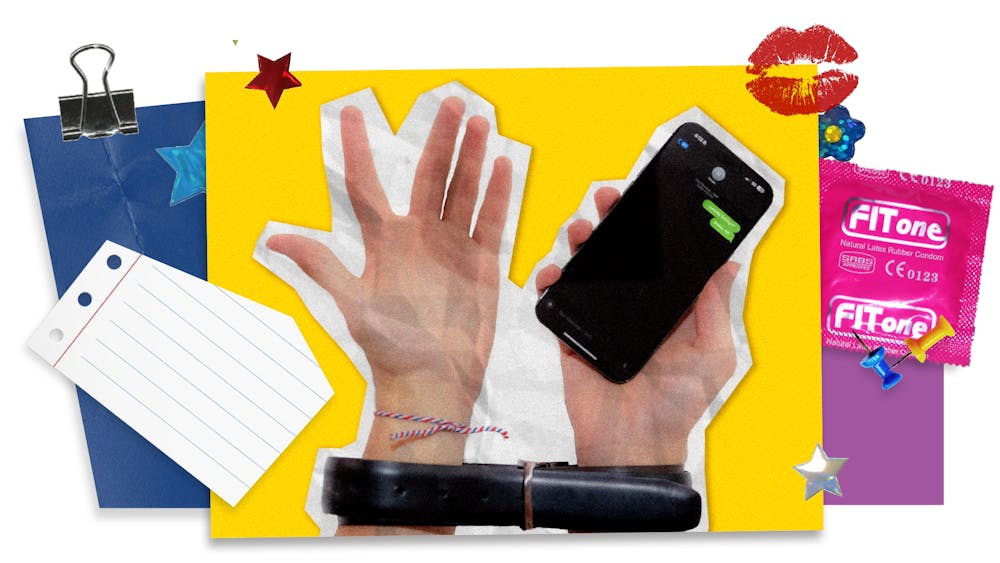
Earlier this summer, The New Yorker boldly asked, “Are young people having enough sex?” Now that the latest generation has come of age, it is acceptable, at least legally, to talk about our sex lives. Or, if you believe the current discourse, our lack of it. You’d think Generation Z was either too traumatized to touch each other or too busy role–playing with artificial intelligence to have a real libido. In 2018, The Atlantic reported on what it calls a “sex recession” occurring among young adults following a 14% drop in high schoolers having sex, according to the Centers for Disease Control and Prevention. A new moral panic emerges—older generations are suddenly no longer concerned that young adults are having too much sex, but rather that they are having too little.
The sex panic has rebranded itself: It is no longer about abstinence rings or purity balls, but about “liberation,” “empowerment,” “hypersexuality,” “femcels,” “healing,” and TikToks about “why I stopped having sex.” Everything is either a warning or a TED Talk.
The discourse itself has become more voyeuristic than anything on Pornhub. Generational predecessors treat Gen Z like a single organism: one hive mind of prudish, traumatized, overly online freaks who either can’t get laid or don’t want to. As a flurry of articles floods front pages, it seems the older generations can’t help but obsess over what exactly Gen Z is or isn’t doing in the bedroom.
In The Society of the Spectacle, Guy Debord argues that modern life has replaced direct experience with images and representations. In other words, we don’t even care what happened—we care how it looked. Sex, like everything else in our lives, has been flattened into his concept of spectacle. It’s no longer private, or even particularly transgressive—it’s just content. It’s romantasy becoming one of the top–selling literary genres and asking, “BookTok girlies, what’s the spice level in this?” In a world of OnlyFans, “girlbossing,” polycules, “ethical nonmonogamy” explainers, and kinks as personality traits, the new taboo is ambivalence. You can be queer, kinky, abstinent, hypersexual, traumatized—but you can’t just shrug. You can’t just not know. There has to be a reason, and everyone, it seems, is desperate to diagnose it.
We’ve branded even our disinterest. If you’re abstinent, it has to be aesthetic—Catholic coquette, clean girl, Lana Del Rey core. If you’re into sex, it’s a whole identity package: slutty but responsible, hot but healing, always in control. Even hookups have to come with a lesson. You need a takeaway to justify the risk.
We’ve lost the space for chaotic, uninterpretable sexual behavior. But sex isn’t always narratable. Roland Barthes writes in A Lover’s Discourse that the minute we try to speak about love, we estrange ourselves from it. Intimacy collapses under analysis. It becomes performative, theoretical, and uncanny. The more we try to capture it—the longing, the mess, the “I don’t know why I want him”—the more artificial it starts to feel. Sex works the same way. The more we explain it, the more it slips. And yet here we are, turning everything into a monologue. Into storytime. Into a trauma plot, or a kink diary, or a thread about how our ex gave us a UTI and daddy issues.
In a world where “He rawed me and I still can’t tell if I liked him” is both a meme and a trauma disclosure, we’ve turned sex into a mirror held up to ourselves. We’re spectators of our own lives. We don’t experience sex—we post about experiencing it. We turn it into proof that we’re hot, healing, complicated, interesting. And those people who are having the sex lives that Boomers suddenly seem convinced we should be having—casual, consistent, whatever—never talk about it. Not because they’re ashamed. Because it’s enough to just live it. It doesn’t need to be posted or packaged. It’s not for the gaze.
And then there’s Byung–Chul Han, who writes in The Transparency Society that in a culture obsessed with openness and overexposure, secrecy and ambiguity become radical. Ambivalence becomes resistance. What isn’t explained, shared, or optimized becomes threatening. Silence becomes power. He’s right—and nowhere is that truer than with sex. If you’re not narrating your hookups or labeling your dry spell, people assume something’s wrong.
But sometimes, there is no label. No story. Sometimes you just are. You sleep with someone, and it means nothing. Or it means something, and you don’t want to talk about it. Or it means something different on Wednesday than it did on Saturday. That’s not confusing. That’s life.
Romantasy and smut culture, in particular, sell us what Lauren Berlant would call cruel optimism—the belief that if you’re just hot enough, just good enough at setting boundaries, just healed enough to let the right dom touch you, then sex will finally click into place. You’ll be fulfilled. You’ll have a plot. But for most of us, sex isn’t a breakthrough. It’s not a resolution. It’s punctuation.
Even the “feminist” narratives—your Fleabags, your Emerald Fennell productions—still insist that meaning comes from not having sex. From learning to withhold. From rerouting desire into grief or growth or God. The opposite end of the same stick. Sex must break you or heal you. Euphoria and Saltburn just scream it louder.
In our increasingly pervasive culture, it feels as though there is no room in it for girls to just have sex. No room for the girl who enjoys it and doesn’t post a close friends slideshow. No room for the girl who wants it sometimes and shrugs it off other times. She’s not traumatized enough to be tragic. Not horny enough to be a slay. She’s just living—and that doesn’t sell.
NPR defines “femcel” as “girls and women who are celibate, either voluntarily or involuntarily.” But that makes no sense. The whole term “incel”—involuntary celibate—is defined by not having access to sex despite wanting it. It’s about entitlement, resentment, and exclusion. Voluntary celibacy is literally the opposite of that.
The standard is stricter for men. A guy isn’t considered an incel unless he’s failing at sex. But a woman can be called a femcel even if she’s just opting out. The word stretches to include anyone who’s celibate at all—by choice, by circumstance, by boredom, by disinterest.
There’s something quietly misogynistic and misandrist about that. It assumes men will always want sex, and if they don’t get it, they’ll become dangerous. But women? If they’re not having sex, it must be part of some pathology—repression, pick–me syndrome, performative tradness, a trauma response. The language builds in the assumption that women must always be in relation to desire—even when they’re saying no.
People who are genuinely content with their sex lives—whether it’s frequent, infrequent, monogamous, chaotic, or barely happening—usually don’t talk about it all the time. Not because they’re ashamed, but because there’s nothing to prove. Their intimacy isn’t for audience consumption. It’s private, not in the romanticized, candlelit sense, but in the nonperformative sense. It doesn’t need to be explained, aestheticized, or used as narrative currency.
We’ve built a culture where sex has to be explained, branded, or turned into content to be considered real. And if you’re not doing that—if you’re not sharing, processing, oversharing—people assume you’re ashamed or repressed. But maybe the refusal to narrativize isn’t a lack. Maybe it’s a boundary. Maybe it’s resistance.
There’s a difference between secrecy and privacy. Between repression and disinterest. Between being broken and just not giving everyone access. And if there’s any kind of sexual liberation worth protecting, it should include the right to say nothing.