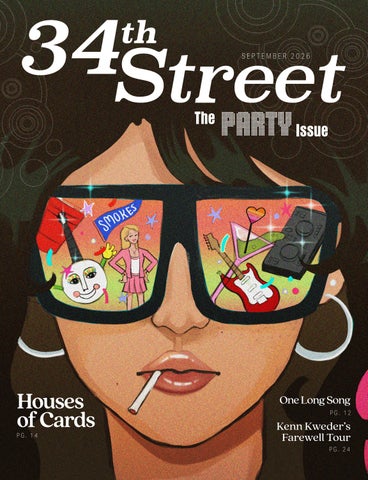

Every year, new moments enter the cultural zeitgeist—new slang becomes ingrained in our vocabulary and political figures become our little dolls to jerk around. With the increasing pace of online trend cycles, it can be difficult for anyone not chronically online to catch up. Luckily, Street has alarmingly high screen times and endless burner accounts. On the off chance you somehow missed whatever six–seven is, or the momentous Zohran Mamdani win in the New York mayoral race, Street’s got you covered.
—Jules Lingenfelter, print managing editor
New York Mayoral Race
It’s a crisp November evening when the news hits: New York has fallen. Against the odds, the radical commie–Muslim hybrid Zohran Mamdani has toppled the Cuomo dynasty and eviscerated city vigilante Curtis Sliwa. Come Jan. 1, 2026, the world's cultural capital will inaugurate its first Muslim mayor and establish the West’s first Shia caliphate. In honor of the new leader of the nation’s Democratic party, please join me in reciting the Shahada: “Ashh–adu an la…”
In all sincerity, New York’s 2025 mayoral election had eyes watching from across the nation and around the globe. Beyond its record–breaking numbers and glass–shattering result, it also gave us all a delightful cast of characters to watch as they duked it out—from charmingly corrupt and incompetent incumbent Eric Adams’ TikToks to the heartwarming bromance between New York Comptroller Brad Lander and Mamdani. This election inspired hope for progressives all over, and a great Halloween costume for me—sexy Curtis Sliwa.
—Insia Haque, Design editor
The Eagles Win the Super Bowl
My joy started before the final whistle even blew. Arts editor Logan Yuhas and I had already left the watch party after Kendrick Lamar’s performance and were instead prancing from house to house, stealing bites of catered halal food and partaking in the unlimited flow of drinks and green Jello shots. Decked out head to toe in green, I was armed with my screen–printed green Philadelphia Eagles bag that soon brimmed with snacks, more drinks, and stray treasures. When the win eventually came, we stormed Broad Street with the rest of Street, screaming into the freezing night, swept up in the delirium of victory with absolutely no idea what had actually happened in the game.
The city was on fire: illegal fireworks singeing the top of my head and strangers turning instant friends as Philadelphia’s population spilled onto Broad Street. We climbed a salt truck in the freezing air, screaming as Chick–fil–A nuggets, confetti, and joy rained down around us. For one perfect night, the world was nothing but green lights and the chorus of “Go Eagles!” echoing through the city.
—Fiona Herzog, assignments editor
The Goon Squad
If you saw my Twitter—the platform formerly known as X—feed on Oct. 22, you’d probably think I was an online freak behind the safety of my anonymous account. But alas, my intentions were wholly pure and journalistic in nature. Daniel Kolitz of Harper’s Magazine put forth a nearly 8,000–word deep–dive into the world of gooning. Suddenly, this niche internet community was opened up for the world to see—in all of its gory details. From defining what makes a “gooner,” to exploring the ephemeral nature of “the goon state,” and the architectural, technological wonder of their “goon caves,” this long–form piece was a total tell–all and many were eager to read. To vastly mixed reviews, “The Goon Squad” set afire new online discourse, with some calling it a perverse voyeuristic experiment and others comparing it to Joan Didion’s own Slouching Towards Bethlehem. As a lover of long–form journalism, I found myself cautiously optimistic at the attention the piece received. Are we swinging back into an era of 40,000–word articles? I can only hope that any way you slice it, the attention “The Goon Squad” received will encourage a revitalization of the genre that I can only hope to one day partake in. But for now, a girl can only dream.
—Jules Lingenfelter, print managing editor
A Defense of “Six–Seven”
Allow me to play devil’s advocate. What is the problem with “six–seven” and can you explain it without sounding bitter and old? Our time is up. We’re not the kids innovating on humor anymore. We’re doomed to repeat the errors of the generations preceding us, hating on things simply because we don't understand.
Six–seven is remarkable in that its origins aren't secretly a 4chan–born Nazi dog–whistle or Islamophobic artificial intelligence–generated content–slop. Six–seven is derived from the song “Doot Doot (6 7)” by Skrilla, a Philadelphia–born and raised rapper. It was used in edits of Charlotte Hornets player LaMelo Ball’s highlights due to his 6–foot–7 height. These edits drew widespread notoriety after being referenced by a high school basketball player named Taylen Kinney, from whom the final version of the joke, with its accompanying hand gesture, was born. And now, children of all backgrounds are screaming it—isn’t that kind of sweet?
We should learn from the mistakes of previous generations and relish in the wholesomeness of six–seven.
—Insia Haque, Design editor
Louvre Robbers
On a street perpendicular to the Seine, in broad daylight, four little musketeers—or rather, yellow–jacketed amateurs—climbed the ladder of their Böcker construction lift truck. Ever since some crown jewels none of us knew existed disappeared on the back of motorcycles, high–vis jacket and cheap costume jewelry sales have gone up on Amazon. Meanwhile, Böcker launched a new ad campaign titled “quiet as a whisper,” in reference to the robbery. To some, it might have been seen as a security breach, but to others, it was the most entertaining piece of news since the tumult of United States politics, a new Halloween costume, a trend of Instagram reels to romanticize, or the start of a new marketing campaign. I’m just relieved “Venus De Milo” is still intact.
—Anissa T. Ly, Ego editor
Bill Clinton x Donald Trump
For Bill Clinton, it was probably hard being casual when his wife faced his paramour on a national debate stage over and over again during the 2016 presidential election. Among the thousands of mentions of President Donald Trump (W ’68) dispersed among 20,000 pages of recently released documents from convicted sex offender Jeffrey Epstein’s files, one phrase has captured the imagination of the internet: “Trump blew Bubba.” Once our finest internet warriors equated “Bubba” with the 42nd president of the United States, it was off to the races. The concept of Trump having a homosexual, star–crossed love affair with his former opponent’s husband is a reality almost too absurd to comprehend—but if you’re watching the stitched–up TikToks of Trump praising Clinton, you might just start to consider the possibility of our country’s first (openly?) bisexual president. If I had a nickel for every prominent Penn alumnus that Street has crowned as bisexual in the past year, I’d have two (see: Luigi Mangione)—which isn’t a lot, but it’s really weird it’s happened twice.
Coincidentally, “Bubba” is also the name of Epstein associate Ghislane Maxwell’s horse. Choose your path wisely.
—Diamy Wang, executive editor
Holding Space
Gone are the days when celebrities were meticulously trained in PR. Now, they just pretend to know what is going on in their interviews when they clearly don’t. Enter “holding space”—a phrase used in an interview that became a viral meme.
When Wicked co–stars Ariana Grande and Cynthia Erivo sat down with journalist Tracy Gilchrist, no one expected the conversation about the film’s hallmark song “Defying Gravity” to turn into a meme. But Gilchrist’s admission that people were “holding space” for the lyrics—met with Erivo and Grande’s emotional finger–to–finger touching—created something deeply beautiful and meaningful … and slightly bewildering.
The phrase “holding space” exploded across social media, mostly met with ridicule and mockery. Erivo and Grande both later admitted in interviews that they were confused what Gilchrist meant by “holding space,” but decided to play along with it anyway. And you know what? At the end of the day, we’re all confused, too. And maybe we should all hold space for that.
—Samantha Hsiung, deputy assignments editor
JD Vance Edits on X
If there’s one thing the Trump administration hates, it’s public humiliation. Case in point: Why did Trump oppose releasing the Epstein files until he was accused of being bisexual? But for Clinton/Trump fancams to run, JD Vance edits had to crawl. While the first edits, from the account of U.S. Rep. Mike Collins (R-Ga.), were meant to be positive, the trend quickly turned against the embattled vice president, turning him into a girl, a pudgy child, and monsters of various stripes. Every new post slowly mutated his visage, making it ever more ghastly with every passing day. Vance tried to reclaim it, of course, dressing as an edit of himself for Halloween, but the damage was already done. Like couch–fucking allegations, this is the kind of thing that sticks with you, potentially soiling your political brand for a generation.
—Nishanth Bhargava, digital managing editor