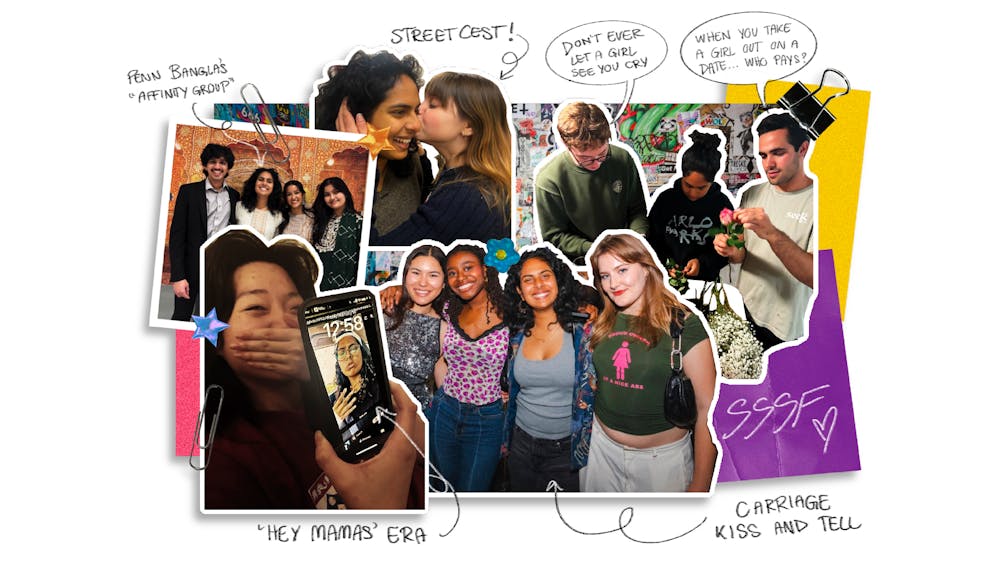
A few weeks after I arrived on campus my first year, a PennQuest leader one year older than me sniffed me out and texted me the details of all things queer at Penn. He divulged the basics: Swalloween is the queer–exclusive Halloween party that everybody who is anybody attends, Wharton Alliance is the application–based Gender and Sexuality Alliance club for corporate A–gays, and Carriage is its equally exclusionary counterpart for artsy queer people who love to party and take photos.
I followed none of that advice. I went to Swalloween exactly once and ended up making out with a lesbian John Lennon. My closest encounter to Wharton Alliance was a friend who called me on the phone during their initiation to try to set me up with a stranger he just met. I hungered for queer community, but I was far too lazy to fill out any application to justify my affinity; nor did I feel comfortable sitting in the basement of the ARCH building divulging the details of my sexuality to a group of people I had just met. Instead, I found my community in the oddest corners: a PennQuest bus ride, incidentally through classes, and, of course, through this goddamn magazine.
To be very clear, this is not a hit piece on organized queer spaces on campus—those are important and serve their own purpose. Instead, it’s an exploration of what the informal “queer community” looks like and what it means for the people who consider themselves part of it. But when I called up the people with whom I’ve discussed the plights of the Scene and begged for dating advice, we couldn’t even agree on what “queer community” even meant.
Cathy Li (C ’25) refers to the “capital–Q Queer community” as politically left advocacy organizations that align themselves with uplifting queer politics—referencing both the Penn Queer and Asian Society and Penn Reproductive Justice as examples. Andrew Lu (C ’27) also references Q&A but views the queer community as a matter of identity and affinity first and foremost. Yet, he also makes the argument that co–ed fraternities (e.g., Elmo) and preprofessional frats are also inherently queer—not in the sense that they recruit their members based on sexuality, but in the way they subvert greek life. While that may be a hot take, Vivian Yao (E ’26) did find her queer community in her preprofessional frat’s queer affinity group, QT (a play on the frat’s name, OT). And when she and I started seeing each other, those were some of the first people she told.
Hannah Moskowitz (W ’26) and I disagree about how to even define the phrase “community.” Hannah thinks the phrase implies a queer–exclusive space. On the other hand, I tell Hannah I see all of my queer friends as part of my “queer community”—even though Hannah had met Vivian exactly once at a formal pregame. Community, to me, implies people I can relate to when asking for dating advice or rely on to call me back within an hour’s notice when we have extra pages to fill in a Street issue.
Considering this definition, Hannah points out the roles that her brothers (“some of the straightest guys ever,” she says) play in making her feel comfortable in her sexuality. I confide in her that I nearly called some of my straight male friends for this article. After all, those are the people with whom I tend to talk about my love life most often—since we all seem to be dating bisexual women.
But this intersectional definition of queer community is far more personal. For Andrew, as a gay man, he describes Penn experience as almost separated from his straight male counterparts.
“It always felt like the queer community was not just a niche part of Penn, but like a different world altogether,” Cathy says. “Like whenever I would rub shoulders with straight women, I would be like, ‘Oh my God, we go to the same school?’”
Hannah imagines that queer people tend to gravitate toward each other because it’s a “visible thing that people wear on their chest,” which means that it can be a lot easier to identify someone as sharing your queerness rather than your same interests. Friendships based on the latter have been far more fulfilling for her. The queer friends she’s found have been through other pathways, such as working on TA staff together or participating in Bloomers Comedy.
I point out that Vivian and I met through working for The Daily Pennsylvanian together, which mirrors her theory. But Hannah pauses, pointing out that the friend who set me and Vivian up is also queer. “I often think to myself, ‘Do I need queer friends to date?’” Hannah says. “I do think that a large number of people seek out queer community because it’s like, how else are they supposed to date?”
But for Andrew, the insularity of queer community has made dating a lot harder. “I definitely suffer from overexposure,” he says, pointing out that the interconnected queer scene can easily devolve into chaos. Most of his friends on campus are queer, a stark contrast from our high school experience in Texas, where he was one of the few out gay men in our high school. That’s part of why he was really intentional about seeking out queer community in college.
High school seems to impact how Penn students experience queer community in college. Coming to Penn, Hannah didn’t place finding queer community at the top of her list. At her New York high school, plenty of people were out at school or in queer relationships. “I guess I kind of just assumed it was gonna happen,” Hannah says. “It’s not that I assumed I would find a community. I assumed I would find queer people that would scratch the itch of having queer people in my life.”
When Emmett, who is using a pseudonym for this article, left for college, his mom encouraged him to find a queer community. Emmett had transitioned in high school, but college gave Emmett an opportunity to go “stealth” and pass as a cisgender man. Emmett instead opted to join a frat and avoid associating with queer spaces on campus. “I came in and I was like, ‘I don’t want to be around those people. I don’t need to be around trans people to be able to function,’” Emmett says.
Emmett spent his first year isolated from other queer people, mainly associating with other men in his frat. But, even in passing as cis, he realized as he went through college that he was denying a key part of himself by denying his queerness.
“My mom was right—I did end up seeking out queer community, and I’m much happier because of it,” Emmett says. “There’s a way you’re thinking about sexuality and gender and self–expression and how you form friendships in a way that people who aren’t [queer] just aren’t gonna get.”
Finding queer community while going stealth can be difficult. Emmett keeps a list of all the people in college who know that he’s trans: in his first year, it was primarily just girls he hooked up with, but as he’s grown more confident and comfortable, he’s begun talking about his transition openly with more people. Over the summer, he even showed a group of guys he was hanging out with his baby photos. Emmett realizes that most people incorrectly assume that he’s bisexual when he identifies with the queer community. “I just wanna be seen as a queer man who likes girls, and it’s kind of an odd thing. It’s not really a thing people know how to deal with.”
He’s not interested in any “big reveal” about his transition, but he has come to the realization that if people were to find out, it wouldn’t be the end of the world. Still, being stealth allows Emmett to pass as cis and offers him a certain veil of safety, especially when he first joined his frat at Penn. “We’re in a world where queer people aren’t necessarily uplifted. Trans people aren’t necessarily safe,” he says.
When I first met Emmett, I had harbored the same jealousy I did of the other straight men in my circle, men on whom I relied for advice but who I recognized were a step above me when competing for the same girls. After a year of us knowing each other casually, I finally became friends with Emmett in his own right. When he disclosed his identity to me while ranting about dating troubles, he said my reaction perfectly lined up with his prediction: a nod of understanding and then an offer to set him up with my friends. Maybe that’s all queer community is.