On April 2, Philadelphia’s Rosenbach Museum and Library received a notice from the National Endowment for the Humanities (NEH). It spelled out the cancellation of nearly $331,000 in federal funding for the museum’s lighting upgrade project. “Your grant’s immediate termination is necessary to safeguard the interests of the federal government, including its fiscal priorities,” the letter read. It continued that the change “represents an urgent priority for the administration, and due to exceptional circumstances, adherence to the traditional notification process is not possible.”
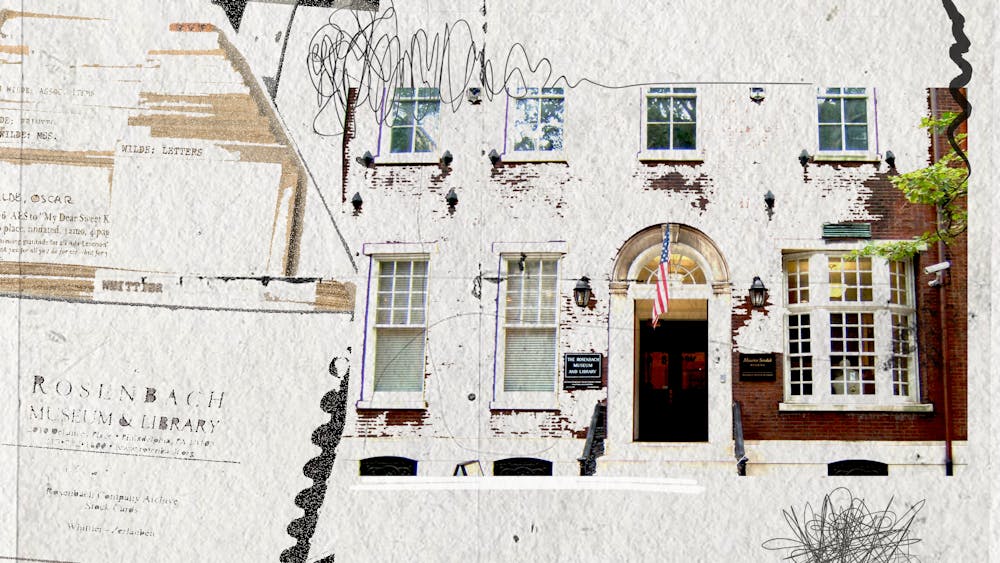
For a small museum, the sudden loss was devastating—and unexpected. The Rosenbach is an institution in Philadelphia’s Center City dedicated to preserving and celebrating the written word. Since opening to the public in 1954, it has brought its collections—which include a manuscript of James Joyce’s Ulysses, Bram Stoker’s notes on Dracula, and a first copy of Poor Richard’s Almanack—into the Philadelphia community through guided tours, programming, and literature courses.
In April, the Rosenbach announced to its members the cancellation of two federal grants. One came from the Institute of Museum and Library Services (IMLS), an independent federal agency tasked with supporting cultural institutions and archives across the country. The other was the NEH lighting grant.
Across the country, museums have been hit hard by funding cuts and ideological pressure from the Trump administration, threatening their positions as cultural hubs and places of shared memory. The grant cancellations this year spotlight museums’ struggles as they face tightened budgets, increased federal scrutiny, and skepticism over their societal value. While many books gather dust, museums are encouraging people to take them off the shelf and engage with them again. With this goal in mind, they are rethinking how to bring in new visitors and create spaces for students of all ages.
The notices of the grant cuts shook the Rosenbach’s director, Kelsey Scouten Bates. “I have written and I have been awarded federal grants throughout my entire career, and there's so much confidence in the federal government that they will reimburse you for a grant that you've gotten,” she says. “You sign an agreement when you get this award, and you go forward and spend the money with confidence. And my confidence was crushed.”
Bates is no stranger to the complexities of financing museum operations. After working in development roles at various arts institutions, she joined the Rosenbach in 2014 as its director of development soon after its merger with the Free Library of Philadelphia Foundation. She describes the moment as a reckoning point for the museum to determine how it would move from an insular building to a more accessible place for the public. Indeed, the building began as an entirely private space, and the past few decades have seen its gradual shift toward community engagement.
The Rosenbach grew from the collections of A.S.W. and Philip Rosenbach, brothers who amassed thousands of rare books, manuscripts, and art pieces throughout the 20th century. Their influence encompassed book donations to several organizations in Philadelphia, including establishing the A.S.W. Rosenbach Lectures in Bibliography at Penn Libraries, the country’s longest–running series of lectures of its kind. Their townhouse on Delancey Street opened to the public after the brothers’ death. It has since become a staple of Philadelphia’s literary community, including hosting the annual Bloomsday festival in June.
When some board members suggested that the museum’s funding might come under threat after Trump’s inauguration, Bates had difficulty believing it. Yet, as the ensuing slew of cuts to federal grants showed, that possibility quickly became reality for arts and cultural groups across the country. The cancellations impacted several institutions in Philadelphia, including the Woodmere Art Museum and the Penn Museum.
“Many museums like us are grappling with the same questions. How do we become relevant? Or, how do we prove our relevance?” says Bates. “That means moving away from traditional ways that visitors engage with objects. It may be moving away from traditional exhibitions, traditional lectures, and thinking about things in a different way.”
The IMLS grant was intended to help with that process of adaptation. The three–year grant, totaling $248,953, would have funded a cataloguing project to make its collections publicly accessible and searchable online. At the time of the grant announcement, the Rosenbach planned to digitize approximately 21,000 books, newspapers, and maps, as well as thousands of manuscript records. Losing the IMLS assurance of reimbursement in April forced the halt of the project. The museum is still searching for funding to pay the contractor, without whom the process of converting paper cards into digital forms will be painstakingly slow.
Bryn Michelson–Ziegler, associate curator and manager of public programs, highlighted the importance of detailed cataloguing for her work. The Rosenbach houses over 400,000 objects across diverse areas such as colonial American history, Egyptian sculpture, and children’s literature. “To be able to find all the things we have, to understand that, it’s a process of a lifetime,” Michelson–Ziegler says. “That [cataloguing] project which was part of the IMLS is vital to the function of the library to be able to serve our public.”
Digitization is a key way that libraries are bringing ancient texts into the 21st century for an increasingly online audience. Dot Porter, curator of digital humanities at Penn Libraries’ Schoenberg Institute for Manuscript Studies, admits that she can’t imagine researching without a digital resource. “It just makes it so much easier to reach an audience and to get people to use your collection if your catalog is available online,” she says.
Porter worked alongside the Rosenbach in 2016 on a project to provide online access to medieval manuscripts from Philadelphia institutions. Penn Libraries contributed the bulk of the digitization work for the final product, Bibliotheca Philadelphiensis (BiblioPhilly), a website housing images of over 160,000 pages. As a principal investigator on the grant, Porter became familiar with the Rosenbach’s curators and collections. Porter now runs “Coffee with a Codex,” a weekly online showcase and discussion of a manuscript from Penn’s collections that began during the pandemic. Building on the University’s relationship with the Rosenbach, she led a session at the museum in October featuring a physician’s belt book. “It’s a really nice, friendly, and cordial environment where people like to share information,” she says. “We're already talking about doing it again next semester.”
In one sense, the rise of digital technology is testing the relevance of rare book museums like the Rosenbach, which presuppose the value of material interaction with books. But especially since the pandemic, libraries and museums are also using technology as a tool to share their resources with a wider public, as Porter did with Coffee with a Codex. The IMLS grant had the potential to make the Rosenbach’s collections accessible to a wider group of Philadelphians. However, as long as funding is unavailable, it is unlikely that the museum will be able to complete its cataloguing project.
The NEH grant termination struck at another one of the museum’s most fundamental needs. It was initially awarded $330,977 to fix the house’s broken lighting system. According to Bates, the Rosenbach had spent almost the entirety of the funds when they discovered the grant was terminated.
Michelson–Ziegler explains that the lighting project, which might seem like a mere operational update, is essential for protecting and showcasing the rare items in their cares. “[The new lighting] is safer for the objects, it’s safer for the books, it’s easier for our audience, it’s easier to see,” she says.
While the Rosenbach was able to partly recover NEH funding by submitting project expense reports, Bates characterized the information coming from the NEH throughout the process as conflicting, infrequent, and irregular, which contrasts with the transparency of the NEH before Trump.
As organizations across the country grappled with the disruptions, the NEH released a statement explaining the elimination of offices and funding streams. It stated that among the terminated awards were those that did not align with the agency’s new priorities or “may not inspire public confidence in the use of taxpayer funds”—a catch–all for the sweeping cuts that had taken place. In March, IMLS and the Smithsonian Institution were also the targets of a March Executive Order titled “Continuing the Reduction of the Federal Bureaucracy,” which sought to minimize the personnel and non–statutory functions of the organizations. While advocacy organizations sued the administration over its dismantling of the IMLS, personnel and funding cuts could remain in place as the case proceeds into the fall.
The accumulation of unknowns is influencing how the Rosenbach staff approaches future projects. “Federal grants are cumbersome. The applications are cumbersome,” Bates says. “It takes a lot of staff time to even apply for a federal grant, and I'm hesitant to put that staff time in when things are so uncertain.”
As a result of the incomplete NEH award, not every part of the museum originally scheduled for the next phase of the upgrade received those benefits. When Michelson–Ziegler introduced me to the History of Material Texts collection, the motion–activated lights refused to turn on when she waved a hand. Only on the third try did they finally flicker on. Michelson–Ziegler made a note to have someone check out the room. It’s a marked contrast to the newly installed chandeliers on the first floor, which smoothly lit up when we walked into the room.
So much of the visitor experience of the museum relies on being able to fully experience its physical spaces. The interior of the 1860s townhouse is a special object in and of itself, from the busts and paintings on the first floor to the detailed recreation of Marianne Moore’s living room. Steve Bartholomew, the Rosenbach’s visitor experience associate, can attest to the meaning and emotion that people find in the museum’s shelves. He has worked as a tour guide for 25 years.
His involvement began when he participated in a book club that met in the townhouse. On the day they were reading Alice in Wonderland, the librarian brought out items from the Lewis Carroll collections (the Rosenbach holds the author’s copy of a first edition Alice). Bartholomew, amazed at the materials in front of him, enrolled in a free course for training docents. Today, Bartholomew is a part–time tour guide and true fountain of literary knowledge, capable of launching into a story on any bookshelf, vase, or footstool in the building.
He gave a memorable tour a few weeks ago to an older couple. As he spoke about the library, the woman walked around the room looking at the shelves. At one point, she went to the floor and peered at something closely. “Her husband says to me, ‘She’s crying.’ And I was hoping it's not something I said,” Bartholomew recalls. “She started to get emotional with the Dickens here, and then the Lewis Carroll, then the Frankenstein, and now she's at Ulysses, and now she's at E.E. Cummings.” When the couple came down the stairs at the end of the tour, the woman was still crying.
Encounters with young people also stand out to Bartholomew. He recalls another tour when a man and his son came to the museum from out of town to see a baseball game. While Bartholomew was speaking with the father, his son came running over to point out the Herman Melville bookcase. Although the visitors did not book a tour in advance, Bartholomew found a way to offer them a quick look into the upstairs galleries. “Anyone who comes in with this passion, this love of books, you do what you can for them,” he says.
Paul Hirsch, who volunteers as a tour guide at the Rosenbach and the Penn Museum, puts it another way; he aims to make visitors comfortable by “breaking down the barriers” between the museum as an artificial space and its visitors. “It’s to humanize what museums are,” he says. “They're not just collections of ancient books or ancient artifacts.”
Another way that museums remain relevant is by engaging people across generations, tapping into a shared interest in stories and literature. Bates has been thinking through these questions in the context of the crisis for cultural institutions. As someone who articulates the Rosenbach’s mission to the public, she has found herself focusing on two elements: rediscovering meaning in literature as an adult and doing so in dialogue with other community members.
“A typical person who takes a course at the Rosenbach is someone who maybe read Pride and Prejudice when they were in high school or college, and it touched them somehow,” she says. “Maybe they've gone on to become a lawyer or financial advisor. Even if they find great value in their work, they are missing the meaning that is so present in art and, in this case, in literature.”
Plenty of Penn students can relate. Of 211 English majors graduating between 2020–2024 who reported their outcomes to Penn Career Services, less than 10% enrolled in continuing education in the humanities. The numbers are similar for graduating history majors. While these statistics are inexact, they hint at a pattern of adapting one’s humanities education to other employment choices, whether consulting, law school, or elsewhere in corporate life. Although college may represent the most condensed period of literary immersion for many students, leaving the academic environment does not necessarily mark the closure of that type of thinking and discussion. It doesn’t have to mean only reading in the solitude of one’s apartment, either, relegating one’s engagement with books to the occasional Goodreads post.
Danielle Bergmann is someone who has been able to pursue a love for the written word in community alongside her professional life. After studying English literature and history at the University of St. Andrews, she now works as a paralegal in Philadelphia. Her job involves a lot of writing, but as she says, it’s not exactly creative or literary. Five years ago, she found herself missing that dimension of her life and wanted deeper engagement with a text than a book club might provide. After coming across the Rosenbach’s course offerings online, she registered for a class on women in the early American republic. In addition to discussing writers such as Phillis Wheatley, the instructor included materials from the collections. While the course structure reminded her of university, Bergmann notes that there were no essay assignments or grades: “All the good stuff, without the academic pressure.”
Another difference was the group of students, which included several retired people. “You get a lot of really good conversations, different perspectives on things—all the stuff that you crave, especially these days, where things are a bit more online and just a bit more sanitized,” she says. She has taken four courses since then, including an 18–week course on Ulysses.
Bergmann’s involvement in the Rosenbach extends beyond the courses. She is part of the Young Friends, a group formed after the pandemic to broaden the museum’s appeal to the public. “The Rosenbach has become the center for this type of connection and communication, almost investigation, pushing yourself to read something that maybe you read as a kid but didn't really read that closely, or you want to read again,” she says.
Penn students in all fields of study may view college as the last structured opportunity to explore literature. The Rosenbach stands as an alternate hub of literary discovery, one whose programming will remain open decades after they graduate—that is, unless the administration’s current attack on cultural institutions darkens that possibility in the long term.
For now, Bergmann suggests that the gatherings made possible by the Rosenbach offer a kind of cure for the loneliness and frustration generated by technological spaces. “There are places where you can connect with people. There are places that will encourage you to read a book over weeks instead of seeing how quickly you get it finished.” She adds, “Education doesn't ever have to end. We don’t have to limit ourselves.